I have been waiting on this one since the September reveal, and with Thursday close, Nintendo has been unloading information all week. The Legend of Zelda: Ocarina of Time arrives on Thursday, November 5, 2026, rebuilt from scratch for Nintendo Switch 2. As of this morning, Tuesday, November 3, Nintendo has just published the third and fourth parts of its long Ask the Developer interview, the review embargo is expected to lift in the next day or so, and the preload has been sitting on consoles for almost a week. That makes today a good day to sort out what is official, what is a reasonable guess, and what you should do tonight so launch night goes smoothly.
This guide sticks to primary sources wherever possible: Nintendo's overview trailer post, the four-part Ask the Developer interview, Nintendo's own support pages for eShop release times and pre-orders and pre-loads, and the original announcement as reprinted by Gematsu. Where only third-party coverage exists, I say so. If you want the earlier overview from when the remake was first revealed, our original Ocarina of Time remake guide covers the September announcement.
Release Date and Unlock Time
The date is locked: Thursday, November 5, 2026. Nintendo says it plainly on every page, and the Ask the Developer interview opens with the same line. It releases in North America, Europe, the UK and Australia on that date.
The hour is the part people keep asking about, and the honest answer is that Nintendo has not announced an exact unlock time for this game. What we do have is a published Nintendo rule. On its support page about when new games arrive on the eShop, Nintendo says digital software that is also sold physically will usually be available at 9:00 PM Pacific the night before the physical release date, and that the exact time is decided by the publisher and may vary by title. Ocarina of Time is sold both digitally and physically, so the usual rule points to Wednesday night.
Keep two warnings in mind. First, the clocks changed on Sunday, November 1, so Pacific Time is now UTC-8 and Central Time is UTC-6. The gap between them is still two hours, which is why 9:00 PM Pacific becomes 11:00 PM Central. Second, Nintendo's own wording is "usually," and the table above is an estimate built on that. Game Beacon and Vice both landed on the same math, and both call it an expectation, not a confirmed time. If your plan depends on playing at a specific minute, check the game's eShop page on Wednesday evening, because that is where a different time would show up first.
How the preload unlock works
Nintendo's pre-order and pre-load FAQ explains the mechanics. When you pre-order on the eShop, payment is processed no sooner than seven days before release, and a non-playable version of the game is pre-loaded onto your console. You see the icon on your HOME menu, but you cannot launch it until the release moment, when a small update unlocks it. If your Switch 2 is online and in sleep mode, that update downloads and installs by itself. If it is not, you will be prompted to download it when you launch the game.
So the practical checklist for Wednesday night is short:
- Leave the console connected to Wi-Fi and put it in sleep mode, not fully off.
- Make sure the system software and your Nintendo Account are up to date now, not at 10:55 PM.
- Confirm the game icon is on your HOME menu and shows as pre-loaded.
- If you want to play the minute it opens, launch the game to trigger the small update if it has not already installed.
Price, Editions and Which Version to Buy
Pricing was confirmed in September and has not changed. In the US the game costs $59.99 digital and $69.99 physical. Nintendo Life lists the digital price as £49.99 in the UK and 59,99 euros in Europe, and Game Beacon lists the same figures.
There is only one edition of the game itself. Nintendo's announcement says the first print run of the physical version has special packaging with textured foil cover art, available while supplies last. That is the entire collector angle for the game; there is no Collector's Edition box with extras. Some retailers have also discounted physical pre-orders: coverage in late October reported $59.99 listings at Amazon and Walmart, and Vice saw an Amazon cart price of $59.88 with a price guarantee through the end of release day. Prices at retailers move around, so check yours.
Digital versus physical comes down to storage and habit. The physical version is described in launch coverage as a full cartridge, meaning it should not force a download before you can play. The digital version needs a lot of room, which brings us to the next section. If you buy digital in the US before November 23, Game Beacon reports a Zelda 40th Anniversary wallpaper bonus as well. I would treat that as a small extra, not a reason to pick a format.
One more buying note: this is a Switch 2 exclusive. Vice put it bluntly, if you are still on the original Switch you are shopping for two things. The Zelda 40th Anniversary Edition Switch 2 console went on sale October 29, but according to Game Beacon it does not include the game, so budget for the cartridge or download separately.
Download Size and Storage
This is the one detail that has changed the most in the last few days. The US eShop page has listed an estimated 27 GB, while the UK listing shows 24.5 GB, and players who preloaded early reported figures closer to 24.5 GB. Then on November 2 Nintendo of Japan posted that the digital version needs 27.0 GB or more of free space, according to Notebookcheck's report. Depending on how the translation is read it means "more than" or "at least" 27 GB.
My read: the gap probably comes from temporary files during installation and from a possible day-one patch. Nintendo has not said that a patch exists, and there is no evidence of one yet, so I would not claim it. What I would do is plan for around 27 GB plus a few GB of headroom.
For perspective, that makes Ocarina of Time the largest mainline Zelda game on Switch 2. Notebookcheck's comparison puts the Switch 2 Edition of Breath of the Wild at 24.1 GB and Tears of the Kingdom at 20.1 GB. The original 1998 cartridge held 32 MB.
Storage tips that matter:
- The Switch 2 has 256 GB of internal storage, and a few modern games fill it fast. Archive or delete something you are not playing now, not on Thursday morning.
- Nintendo's Japanese notice suggests deleting Switch 2 games you no longer play or using a microSD Express card, which Notebookcheck calls pricey. If you do not want to buy one, the physical version avoids the whole problem.
- A preloaded game already takes its space, so check your free space after the preload, not before. If the console is warning you, fix it before launch night.
Reviews: What We Know and What We Don't
As of this morning, there is no published Metacritic score and no OpenCritic score for the Switch 2 remake. Metacritic's own account has told fans to watch for activity midweek, and Notebookcheck's reporting notes that Nintendo's recent first-party Zelda games, including Breath of the Wild, Tears of the Kingdom and Echoes of Wisdom, all had reviews surface the day before launch. That points to Wednesday, November 4, but nobody has confirmed an embargo time.
The bar is absurdly high. The Nintendo 64 original sits at a 99 on Metacritic, the highest score on the site. The 2011 3DS version earned a 94. Notebookcheck's comparison shows the usual pattern for Nintendo remakes: Link's Awakening on Switch registered an 87 against the original's 90, and Skyward Sword HD dropped from 93 to 81 in the comparison it cites. Previews have been positive, praising the visuals, music and controls, with some caution about how combat and design changes feel. I will not guess at a score, and neither should you. Wait for the real numbers, and if you are on the fence, read a few written reviews instead of trusting a single aggregate.
One side note about spoilers. Reports at the end of October said physical copies had leaked to some buyers before the release date, so screenshots and clips are already floating around. If you care about going in clean, mute the obvious keywords on social media now.
Who Made It, and Why
Nintendo cleared up months of rumor on November 2. The first two parts of Ask the Developer Vol. 24 confirm that the remake was developed in-house by Nintendo EPD Production Group No. 3, the same team behind Breath of the Wild and Tears of the Kingdom. That was a surprise to anyone who expected Grezzo, which made the 3DS version, or Monolith Soft, which an early retailer listing had pointed toward.
The named leads are:
- Director: HokWai Ng, who joined Nintendo as a planner in 2006, worked on game design for Tears of the Kingdom, and is directing a Nintendo project for the first time.
- Producers: Eiji Aonuma and Hidemaro Fujibayashi. Aonuma has worked on every Zelda since the original Ocarina of Time. Fujibayashi directed Breath of the Wild and Tears of the Kingdom.
- Art director: Aya Shida, with earlier work on Pikmin 3, Mario Kart 8 Deluxe and Tears of the Kingdom.
- Program director: Hiroki Taguchi, who joined the series on Breath of the Wild.
- Music lead and sound director: Masato Ohashi, who worked on Animal Crossing: New Horizons and Tears of the Kingdom.
The team's guiding line, taken straight from Part 2, is "the visuals may change, but the experience does not." Keep that phrase in mind, because it explains almost every change below.
What Is Actually New
Here is the verified list, sorted by what you will notice first.
Visuals and art direction
Nintendo says the visuals were completely overhauled down to the texture of each material. Shida describes the art goal as a dense, believable Hyrule that still keeps the dreamlike contrast of a slightly dark world full of colorful, quirky characters. Early development keywords were "a puppet-show feel" and "the analog feel of practical effects films." The team built a Great Deku Tree model first to prove the look, researched real fabrics for Young Link's clothes, and says every object got a story behind it.
The world keeps its separate map structure. Ng says they deliberately did not make the world seamless, because the original's area-by-area pacing is part of its appeal. A new map was drawn by the artist who made the illustrations for the Nintendo 64 version. In Hyrule Field, areas you can explore have high detail, while unreachable areas use less detail and landmarks like the castle and windmill are enlarged to guide the eye.
Controls and camera
Part 3 of the interview came out today and is the most useful one for players. The team recreated everything from scratch and compared each feature to the original over and over, with particular attention to the hard-to-describe responsiveness of Link's actions.
A few details stand out. Ng says auto-jump was removed because players used to modern Zelda games would wonder why Link could jump in one spot and not another. Aonuma admits that letting players jump anywhere meant the team had to anticipate far more behavior in level design. He also found the two-step Jump Attack unsatisfying and asked for the one-press version back, so both control schemes exist and neither gets in the way of the other. The same goes for dashing: you can keep spamming Roll Attack across Hyrule Field like the old days, or hold the button to dash.
The free camera brings a navigation problem, so the team added adjustments to make it easier to see where you are headed after a room opens. Taguchi also says that when you revisit a place as Adult Link that you first saw as Young Link, you may think it feels smaller, and that is intentional.
Dungeons and bosses
Dungeon mechanisms are basically retained, with small changes for playability. Ng says objects are placed so players intuitively figure out which way to go, so you may notice slightly different layouts. Aonuma calls the Water Temple "overdue homework." Item toggling is much easier, and walls that made it easy to lose your sense of direction became lattice-style structures, so you can see the rooms beyond them. Gohma now guards its weak point with the two arms on top of its head whenever it is immune, which fixes the old problem of not knowing when to attack.
There is also a story detail from Part 1 I enjoyed: Aonuma asked for new warp points because he was tired of watching players roll across Hyrule Field. After testing them, the team realized they were losing the moments of discovery along the way, so they took the warp points back out.
Voices, music and sound
The cutscenes are fully voiced with expanded dialogue, and Part 4 says the team protected iconic lines, naming Navi's "Listen!" as the example. Auditions were blind in Japan, hiding actor names, and one chosen actor turned out to have voiced the same character in the Nintendo 64 version.
For music, Ohashi says there are more than 150 pieces of background music, all recorded with a full orchestra. He avoided putting a full orchestra on small spaces like a house interior, keeping the original's idea that scale comes from the composition. Some tracks blend a live orchestra with recreated sounds from the Nintendo 64 sound source, and Link's house is the example Fujibayashi gives. The game supports 5.1-channel surround, and Ohashi says headphones on the Switch 2 give you the benefit of the ambient mix in places like Kokiri Forest.
Threads of Time
A new feature called Threads of Time lets you check your story progress and next objective at any point. As you play, illustrations and passages of text unlock and a single large illustrated story panel fills in. Ng says the idea came from imagining parents who played the original now playing with their kids, with the finished piece as a conversation starter.
Ocarina play and the microphone
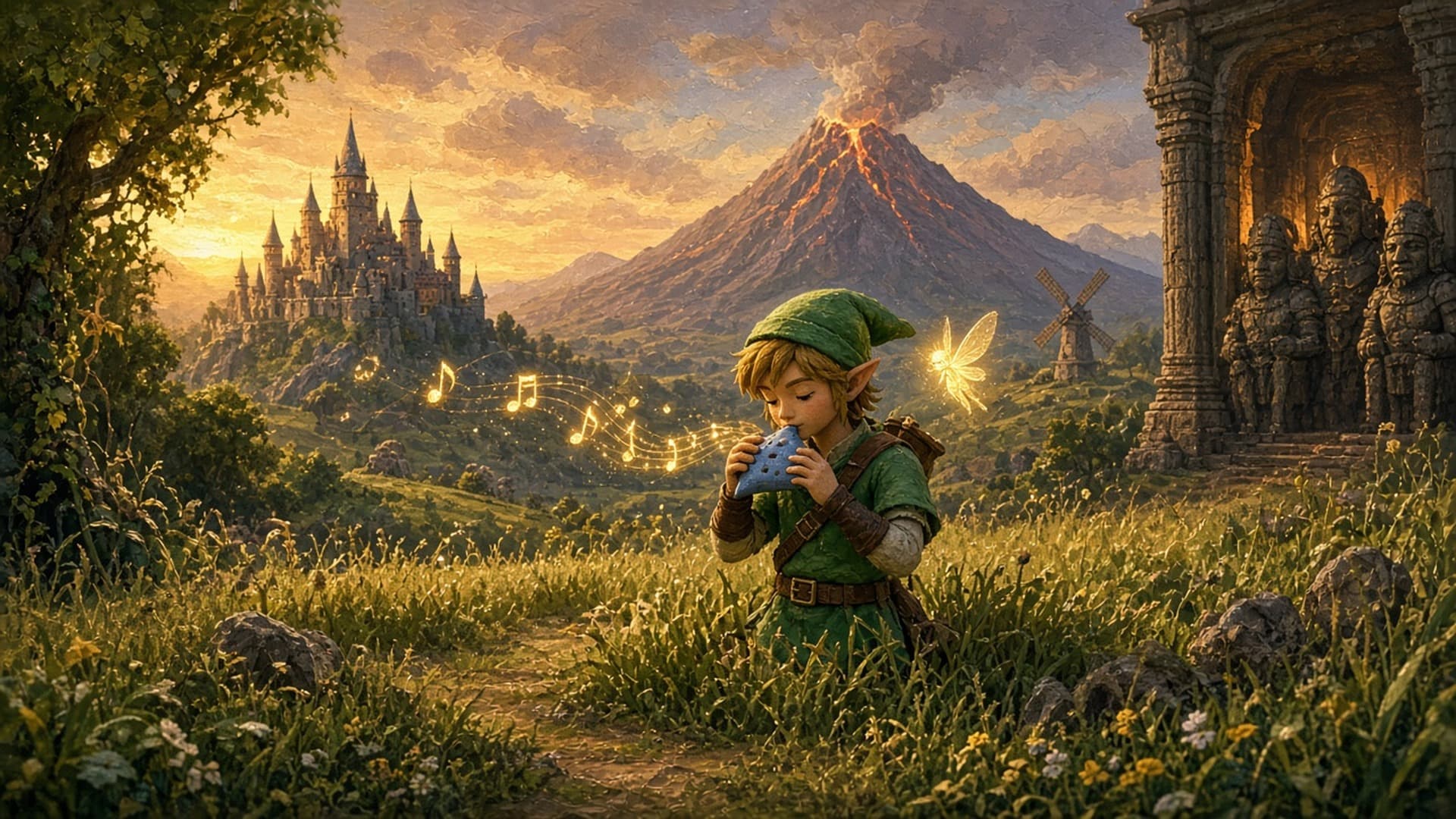
This is the headline gimmick. Hum or whistle a melody Link has already learned within range of the Switch 2's built-in microphone and he will play it on his ocarina. Nintendo says the game also responds to real instruments, including two ocarinas arriving later this year: a playable one and an electric one from HORI. Aonuma says it was his idea about a year ago, and Fujibayashi says the team struggled with recognition. Aonuma is clear it does not make progress easier. Expect it to be a novelty you either love or ignore.
Hall of Fallen Heroes
The Hall of Fallen Heroes is a place where statues of defeated monsters stand, where you can learn about them or fight them again. That sentence is the full extent of Nintendo's own description in the overview trailer post. Trailer coverage, summarized by New Game Wire, describes timed boss rematches with a displayed completion time, with King Dodongo as the example and glimpses of Gohma, Phantom Ganon, Volvagia and Twinrova.
What is not confirmed: where the hall is, how you unlock it, whether every boss gets a statue, whether there is a gauntlet mode like the 3DS Boss Challenge, and whether rematches give rewards. Do not assume rewards. One naming note: some trailer coverage calls it the Hall of Fallen Foes, but Nintendo's own text says Hall of Fallen Heroes.
ZELDA NOTES and amiibo
The game supports ZELDA NOTES in the Nintendo Switch App, which needs a Nintendo Account, a persistent internet connection and a compatible smart device. The Ocarina of Time version includes Today's Record, a daily log with stats like enemies defeated, Gossip Quest, where you match hint images to in-game locations to earn ocarina music scores, a virtual ocarina on your touchscreen with QR code sharing, and a quiz with more than 2,000 questions you can take once a day or take more often by spending in-game rupees.
Two new amiibo, Young Link and Young Zelda, arrive in 2027 and unlock special masks with a retro graphical style. Existing Zelda amiibo will also give useful rewards when tapped.
How I Would Prepare Before Thursday
None of this needs to be complicated. If you have a Switch 2 and the game on order, here is the order I would do things in.
- Check free space now. If you already preloaded, look at what the console says. Free at least 27 GB total if you have not.
- Update the console and keep it online. The unlock update only arrives if you are connected.
- Decide how you feel about reviews. If you like to read them first, the wave is expected on Wednesday, and you can still be ready for release night.
- Plan for the microphone. If you want to try humming, find a quiet room. Nintendo says Link responds to melodies played or hummed within range of the Switch 2's built-in microphone.
- Mute spoilers. Silence the keyword list on whatever app you use.
- Pick your controls. If you are new to Zelda, the jump button is the modern default. If you are a veteran, the option to roll across Hyrule Field is still there.
What We Still Do Not Know
- The exact unlock time for digital copies. The 9 PM Pacific estimate comes from Nintendo's general rule, not from a post about this game.
- Whether a day-one patch exists, and how large it is.
- The final review scores, and the time the embargo ends.
- The Hall of Fallen Heroes unlock condition, location and rewards.
- The release date for the playable ocarina. Nintendo only says later this year.
- Exact US versus UK download size, which differs on store pages.
- Whether Nintendo plans any post-launch content. Nothing has been announced.
Frequently Asked Questions
When does Zelda: Ocarina of Time come out on Switch 2?
The Legend of Zelda: Ocarina of Time launches on Thursday, November 5, 2026, exclusively on Nintendo Switch 2. It releases that day in North America, Europe, the UK and Australia. The game does not run on the original Switch, and Nintendo has not announced any version for it.
What time can I play Ocarina of Time on Switch 2 on November 5?
Nintendo has not announced an exact time for this game. Its support page says digital games that are also sold physically usually unlock at 9:00 PM Pacific the night before the release date, which would be 11:00 PM Central and midnight Eastern on Wednesday, November 4. Because the exact time is decided by the publisher, treat that as an estimate and check the eShop page on Wednesday.
How much does Ocarina of Time cost on Switch 2?
The price is $59.99 for the digital version and $69.99 for the physical version in the US. In the UK the digital price is £49.99 and in Europe it is 59,99 euros. Some retailers have listed physical pre-orders around $59.88 to $59.99, but those prices change.
How big is the Ocarina of Time download on Switch 2?
The US eShop lists an estimated 27 GB and Nintendo of Japan says the digital version requires 27.0 GB or more of free space. The UK listing shows 24.5 GB, and early preloaders reported a similar number. Plan for roughly 27 GB plus extra for any day-one update, which has not been confirmed.
Is there a game-key card for the physical Ocarina of Time?
Launch coverage describes the $69.99 physical edition as a full cartridge that does not require a large download before play. Nintendo's announcement only mentions special packaging with textured foil cover art on the first print run. If a cartridge matters to you, confirm it on the retailer listing before you buy.
Can I preload Ocarina of Time on Switch 2?
Yes, if you pre-ordered digitally. Nintendo's pre-order system charges you no sooner than seven days before release and preloads a non-playable copy to your console. For this game that started on October 29. On release, a small update unlocks it, and it installs by itself if your console is online in sleep mode.
Who developed the Ocarina of Time remake?
Nintendo EPD Production Group No. 3 developed it in-house. That is the team behind Breath of the Wild and Tears of the Kingdom. HokWai Ng is the director, art director is Aya Shida, program director is Hiroki Taguchi, and Masato Ohashi leads the music. Eiji Aonuma and Hidemaro Fujibayashi are the producers.
What is new in the Ocarina of Time remake?
Nintendo lists fully remade visuals, fully voiced cutscenes with expanded dialogue, orchestral music, a free camera with the Right Stick, a jump button, and the Threads of Time progress feature. You can hum or play melodies into the Switch 2 microphone to have Link play the ocarina, and there is a Hall of Fallen Heroes for rematching defeated monsters. ZELDA NOTES in the Nintendo Switch App adds a daily log, a virtual ocarina, hint-based challenges and a quiz.
Is the Ocarina of Time remake an open world?
No. The developers say they deliberately kept separate maps for different areas so each new area keeps the same sense of excitement as the original. Hyrule Field still leads into other regions as it did in 1998. The team also added a new map illustrated by the artist who drew the original Nintendo 64 version's map.
When will Ocarina of Time reviews come out?
Reviews have not been published yet as of the morning of November 3. Metacritic has told fans to watch for activity midweek, and recent first-party Zelda games had reviews land the day before launch, so Wednesday, November 4 is the likely day. That timing is a pattern, not an announced embargo.
What is the Hall of Fallen Heroes?
It is a new area where statues of defeated monsters stand, and Nintendo says you can learn about them or engage them in a rematch battle. Trailer coverage shows timed boss rematches with a recorded completion time. Nintendo has not said where the hall is, how it unlocks, or what rewards it gives, so those details are unconfirmed.
Do I need a Switch 2 to play Ocarina of Time?
Yes. The remake is a Nintendo Switch 2 exclusive, and it will not run on the original Switch. If you want it on launch day you need a Switch 2 console that is set up and updated, plus enough free storage for the download or a physical cartridge.