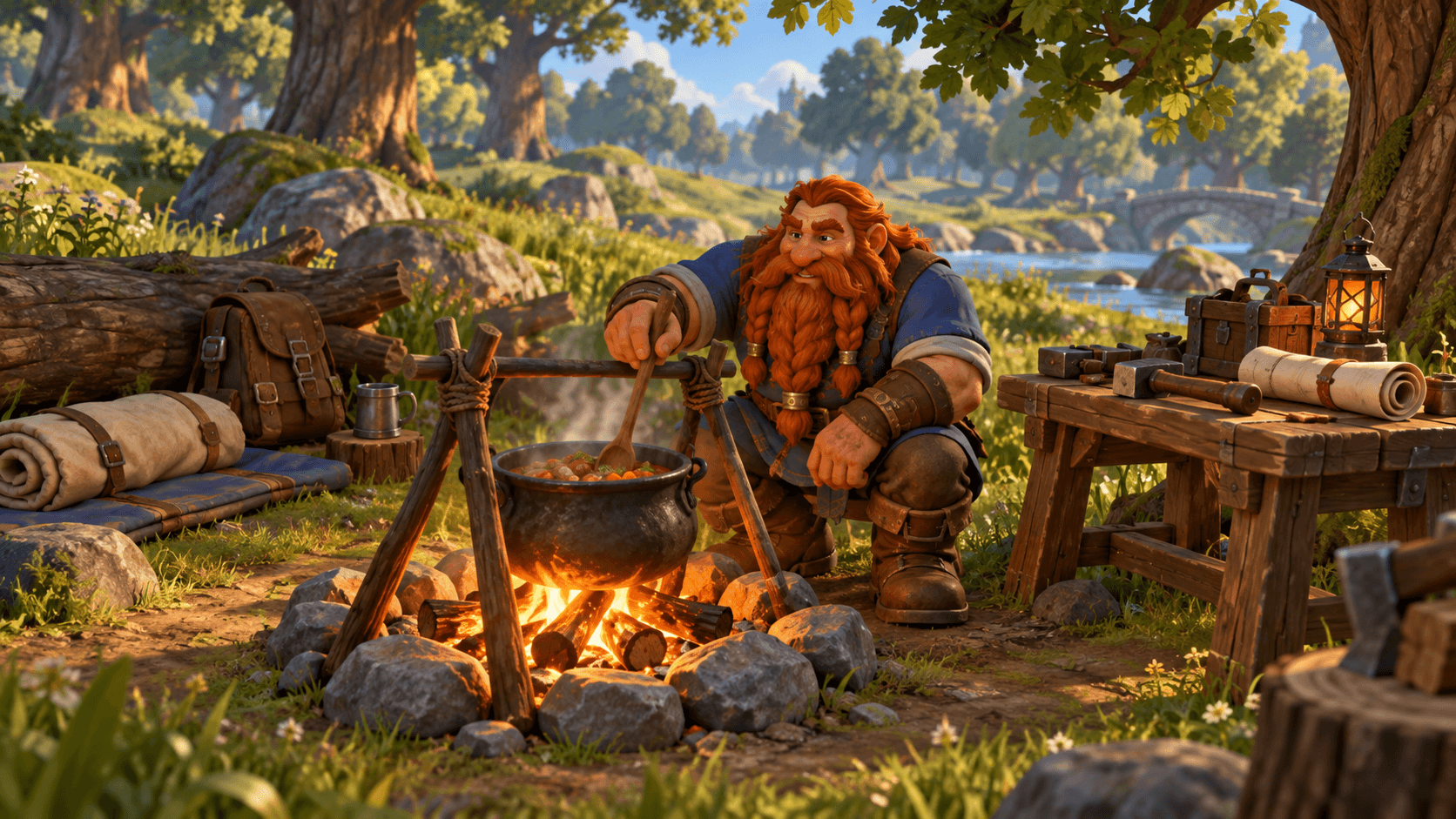
Camping is Forever's social profession layer for the open world. The old Cooking Fire becomes a Basic Campfire that creates a campsite where players rest, repair, buy from temporary vendors, place profession objects, and share short buffs. It exists to turn chance meetings on a quest road into something useful.
This guide explains how campsites work, which profession objects Blizzard has described, how Blueprint upgrades drop from dungeon bosses, which Legacy perks amplify Camping, and how to use camps without wrecking your leveling pace. For gold margins around reagents, see the gold making guide. For account perks that touch camps, use the Legacy Points guide.
Why Did Blizzard Add Camping?
Forever's design pillars put the world and social encounters first. Deep Dive framing is blunt: serendipitous interactions should turn a contested herb node or quest tag into a reason to stop. Camping gives that stop a mechanical payoff.
A campsite is not a tenth primary profession. It is a shared outdoor utility built from Cooking and fed by every profession's crafted objects. If nobody places objects, you still get a rest stop. If three specialists contribute, the roadside becomes a miniature town for an hour.
How Does a Basic Campfire Campsite Work?
Placing a Basic Campfire creates a campsite with:
- A place to sit and rest long enough to gain campsite benefits
- Access to useful services such as vendors, repairs, and profession workspaces
- One-hour buffs tied to contributed objects
- A natural spot to refresh food buffs (Cooking food can grant stats plus a small experience bonus in Forever)
Object slots and cooldowns
- A Basic Campfire allows up to three special crafted objects.
- Each nearby player can contribute one object.
- Contributed objects share a one-hour cooldown window.
- Every profession has three different objects learned across skill levels.
- Each profession provides its own buff or utility no matter which of its objects is placed.
When Do You Unlock Camping Objects?
The first campsite objects for professions are learned around skill level 20, either from special camping NPCs who introduce the system or from profession trainers. Cooking is the on-ramp: the campfire kit exists to build the site itself and is available far earlier than the skill-20 specialty objects.
Practical leveling advice: train a profession you will actually use by the time you leave starter zones. Waiting until level 40 to touch professions means you skip weeks of roadside value while everyone else is dropping Sharpening Wheels and Incense Candles on contested trails.
Which Profession Objects Has Blizzard Confirmed?
Blizzard's Deep Dive calls out clear examples. Community beta lists expand the roster; the table below marks confirmation level.
| Profession | Example object | Effect framing | Source |
|---|---|---|---|
| Blacksmithing | Sharpening Wheel | Attack Power style melee power buff | Blizzard Deep Dive |
| Tailoring | Faction Banner | Spirit buff | Blizzard Deep Dive |
| Herbalism | Incense Candle | Intellect buff | Blizzard Deep Dive |
| Alchemy | Alchemy Lab | Campsite crafting / lab utility | Blizzard Deep Dive |
| Leatherworking | Tanning Rack | Required for more advanced LW recipes | Blizzard Deep Dive |
| Cooking | Upgraded Campfires | Raise object capacity to 5 or 10 | Blizzard Deep Dive |
| Other professions | Three objects each across skill ranks | Profession-specific buff or utility | Blizzard system rule |
Beta coverage commonly lists additional early objects such as Mining Lodestones, Skinning camp chairs, Enchanting instruments, Engineering reagent bots, First Aid kits, and Fishing bowls. Treat those names as beta-observed until Blizzard republishes a full object table. The important permanent rule is already official: every profession contributes, first objects arrive near skill 20, and advanced versions come from Blueprints.
Do Camp Buffs Stack with Class Buffs?
No for the overlapping power buffs Blizzard highlighted. Camp object effects are variants of, and do not stack with, buffs normally provided by specific classes. A Sharpening Wheel style Attack Power effect will not stack with the class buff it mirrors. The same pattern applies to Spirit and Intellect examples.
That design keeps Camping useful when a class buffer is missing without making a full raid buff stack obsolete. In a pickup quest group with no Mage, an Incense Candle matters. In a stacked raid with full buffs, camp power buffs are mostly redundant and the utility objects (labs, racks, reagent bots, upgrades) matter more.
What Are Blueprint Recipes?
Advanced camping objects are not only trainer purchases. Blueprint recipes drop from specific dungeon bosses. That ties profession prestige to adventuring:
- You level the profession to unlock baseline objects.
- You run dungeons for Blueprint upgrades.
- You become the person other players look for when a road needs a rare camp feature.
How Leatherworking's Tanning Rack Changes Crafting
Blizzard specifically notes that Leatherworkers can place a Tanning Rack required for more advanced Leatherworking recipes. That is a infrastructure gate, not only a buff. Expect some high-end LW crafts to assume camp or workshop access rather than a single click at a city trainer anvil.
If you main Leatherworking, practice placing racks on busy hubs and learn which outdoor spots stay safe long enough to craft. If you buy LW crafts, friend a camper who already owns the Blueprint line.
Cooking's Dual Job: Food and Camp Architecture
Cooking sits at the center of Camping:
- Food: Forever food can grant standard stat buffs plus a small experience bonus, which makes food a leveling consumable rather than only a raid flask cousin.
- Campfire upgrades: higher Cooking unlocks campfires that accept five or 10 objects instead of three.
- Legacy synergy: Master Chef improves cook yields; Gourmand stretches food duration; Permanence stretches camp rest benefits.
Which Legacy Perks Improve Camping?
| Perk | Tree | Camping interaction |
|---|---|---|
| Field Guide | Adventure | Reduces the cooldown on adding Camp features (Wowhead: 8% steps across 3 ranks) |
| Permanence | Resourcefulness | Camp rest benefits last longer (Wowhead: 50% steps across 2 ranks) |
| Reagent Economy | Resourcefulness | Tier 1 camping features cost no reagents to craft |
| Gourmand | Resourcefulness | Food buffs last longer (pairs with camp food refreshes) |
| Well Rested | Adventure | Not camp-specific, but stacks with the journey mindset camps support |
| Master Chef | Professions | Extra Cooking results feed food demand at camps |
Remember the launch spend cap is 16 points per character. A Camping specialist can justify Field Guide plus Reagent Economy. A pure race-to-60 alt may skip them entirely for Well Rested.
Best Camping Habits While Leveling 1-60
Early game (1-20)
- Train Cooking and at least one primary profession.
- Place fires at quest hub outskirts, not on top of quest NPCs.
- Sit long enough to receive rest benefits before you sprint off.
- Use repairs and vendors at the fire to cut town runs.
Mid game (20-45)
- Skill professions to 20+ so you can contribute objects.
- Coordinate with party members so you do not all place the same buff type.
- On PvP rulesets, camp in defensible terrain with escape routes.
- Refresh experience food whenever you sit.
Late game (45-60)
- Start Blueprint hunting during quested dungeon clears.
- Upgrade cook fires when your Cooking skill allows larger camps.
- Use camps as consumable and repair stations between Blackmaw Hold or Shaper's Terrace attempts.
- Sell or trade scarce Blueprint crafts if the recipe is bind-on-pickup knowledge rather than a flood of AH listings.
Camping on Each Ruleset
- Normal: camps are social hubs. Expect friendly contributions on busy quest highways.
- PvP: every popular fire is a potential fight. Shorter camps, better sightlines, and escape tools matter. High Alert from Legacy helps against stealth openers outside battlegrounds.
- Roleplaying: camps are narrative stages as much as buff stations. Object variety still matters mechanically.
- Hardcore (post-launch): treat every camp decision as risk management. A repair fire that saves a corpse run is valuable; a careless camp in contested space can end a run.
Professions Strategy Around Camps
Forever adds over 600 new recipes across professions and level ranges. Camping is one reason those recipes matter before max level. A simple planning order:
- Pick gathering or crafting based on your gold plan.
- Ensure at least one character can place a useful camp object by the 20s.
- Keep Cooking on anyone who levels seriously.
- Identify which advanced objects need Blueprints and schedule those bosses.
- Decide whether Reagent Economy is worth a Legacy point for free Tier 1 camp crafts.
Mistakes to Avoid
- Dropping a fire and instantly leaving. Buffs and rest benefits expect you to sit briefly.
- Stacking duplicate power objects when the camp only needs one melee buff and would benefit more from a utility object.
- Assuming camp buffs stack with full class buffs. They are variants and do not stack with the mirrored class effects.
- Ignoring Blueprint dungeons until after launch week demand peaks.
- Building a Leatherworking alt without a Tanning Rack plan. Some advanced recipes require the rack.
- Camping carelessly on PvP. The system is social; the ruleset still kills you.
- Skipping Cooking because you only gather. Food XP and camp upgrades are journey systems.
How Camping Fits the Broader Forever Timeline
From November 4 launch through the December raid unlock, Camping is primarily a leveling and open-world tool. After December 9, expect camps near raid staging zones, Hyjal approaches, and consumable markets to stay relevant as social repair and buff stations even when raid-ready players have class buff coverage.
Future content updates are expected to keep expanding professions and Legacy. New Blueprints and camp objects are natural follow-ons whenever Blizzard adds dungeons or profession columns.
Soft Checklist Before You Log Off Tonight
If you are already in beta or preparing for November:
- Note which trainer or camping NPC taught your first object.
- Screenshot Blueprint drops and boss names when they appear.
- Test whether objects are soulbound knowledge or tradable recipes.
- Time how long you must sit to receive camp rest benefits.
- Compare camp power buffs against your class buff so you know what is redundant.
Frequently Asked Questions
What is Camping in WoW Forever?
Camping expands the Cooking Fire into a Basic Campfire campsite where players can rest, access services, place profession objects, and share short buffs in the open world.
When can you place profession camp objects?
The first specialty objects are learned around profession skill 20 from camping NPCs or trainers. Cooking provides the campfire itself earlier so the campsite can exist.
How many objects can one camp hold?
A Basic Campfire holds up to three special objects, with one contribution per player and a one-hour contribution cooldown. Upgraded Cooking campfires can raise capacity to five or 10 objects.
Do camp buffs stack with Mage Armor Intellect or similar class buffs?
No for the mirrored power buffs Blizzard described. Camp effects are variants of class buffs and do not stack with those class effects.
How do you get advanced Camping recipes?
Advanced objects come from Blueprint recipes that drop from specific dungeon bosses. Exact drop tables should be confirmed in-game as Blizzard publishes or as beta logs stabilize.
Does Leatherworking really need a Tanning Rack?
Yes for more advanced Leatherworking recipes, according to Blizzard's Deep Dive. The rack is a campsite object Leatherworkers place.
Which Legacy perks help Camping the most?
Field Guide shortens camp feature cooldowns, Permanence lengthens camp rest benefits, and Reagent Economy removes reagent costs from Tier 1 camping features. Spend them only if that character actually camps often.
Looking for a WoW Forever account?
Submit a request and tell us what you need.