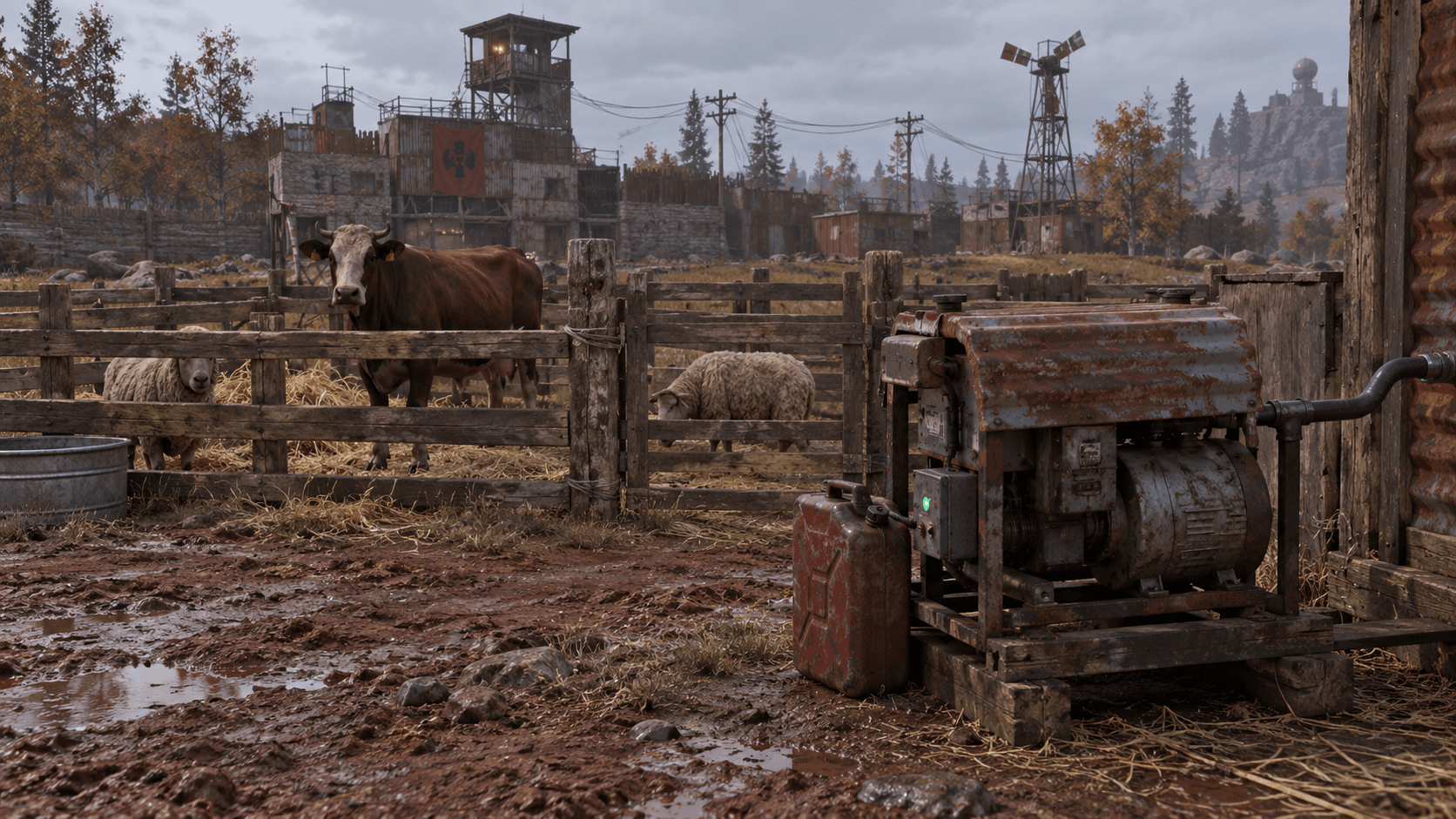
Rust’s October 2026 update is not another skin drop with a couple of QoL notes. Facepunch’s Livestock news post (dated 1 October 2026) frames it as a farming refresh: cows and sheep you can actually raise, milk and wool economies, animal fencing, a Biofuel Generator that finally eats spoiled meat, critters for atmosphere, Powergrid loot rooms across half the monument list, and a wipe-start Air Wolf helipad that clans cannot casually rush alone.
This guide walks the player-facing systems from that official post and the same-day PCGamesN write-up. Numbers below are what Facepunch published. Where the patch notes intentionally refuse exact fuse counts or gene math, we say so instead of inventing them.
What shipped in the Livestock update
The headline feature list from Facepunch:
- New farmable animals: Cow and Sheep
- Milk, Skimmed Milk, and Cream
- Creamy and Milky versions of most pure teas
- New beef and mutton meat, Shepherd’s Pie, Beef Pie
- Wool plus a Stable vendor bartering loop
- Animal fence and gate deployables
- Biofuel Generator (organic / spoiled matter → low grade)
- Decorative critters: frogs, rabbits, squirrels, sea turtles, crabs, jellyfish
- New Powergrid loot rooms at many monuments
- Sandbag barricade rework (four stack stages, pillbox finish)
- Client prediction for grenades / C4 / satchels
- Air Wolf helipad repair gate at wipe start
- Heavy Fuse decay scaling with server population
- Experimental Rust Render Pipeline toggle for the first month
- Plus the usual model refreshes, memory wins, and a long fix list
Livestock basics: cows, sheep, and what they drop
Both animals produce dung. Cows produce milk. Sheep produce wool. Either can be harvested for meat, bones, and leather the same way you already harvest other animals.
That dual life matters. A ranch is not only a soft-food project. It is also:
- a dung source (Facepunch notes horses now drop considerably less dung; livestock are the more efficient path)
- a milk pipeline into teas and cooking
- a wool pipeline into the Stable vendor
- a meat/leather backup if you need to cull a bad clone
- a sellable “finished animal” once grown
Genetics and breeding (not plant genes)
Facepunch is explicit: livestock have genetics and needs, and you can breed toward a god clone, but the genes will not behave exactly like plants. Old plant-gene techniques may not apply. Treat community plant-clone memes as unverified until you have tested them on animals yourself.
Capture methods are left open-ended. The notes say there are multiple ways to grab wild livestock, some more efficient than others, and that they should feel intuitive. When the new navmesh is enabled, NPCs can enter player structures and respect doors opening and closing, which changes how “drive them into a barn” plays versus older animal herding.
Performance note from Facepunch
Facepunch addressed the obvious “will cows tank my server?” question directly. Each frame only processes a subset of NPCs up to a hardcoded max time budget. When population rises, servers do not simply lose FPS in a linear way; NPCs get slower to react because load is distributed across frames. They also claim at least a 2× navigation performance gain since the last patch and say they will keep monitoring. Critters are separately budgeted and described as mostly set dressing for now.
Animal fences and gates
New animal fence and animal gate deployables exist specifically to keep livestock under control. Build a real pen. Do not assume a half-finished honeycomb “probably” holds a sheep when a door opens and the new navmesh decides your base is walkable.
Practical base advice (playstyle, not a Facepunch checklist):
- Put gates on the side you can defend, not the side that opens into your TC core
- Keep a kill corridor or airlock so a raid that hits the ranch does not free-walk into loot rooms
- Plan compost / Biofuel Generator adjacency so dung and spoiled meat do not travel half the compound
- Expect neighbors to grief open pens; ranching is now a raid objective, not just a cute side project
Stable vendor economy: selling animals and wool
Jarryd Campi’s Livestock economy section is the money loop.
Selling grown cattle and sheep
Lead a grown animal to the Stables and talk to the new vendor outside. You get a randomized offer based on the gene quality of the animal. You can reject that offer and receive up to two more alternatives. After the third offer, the vendor gets annoyed and will not buy that animal for 15 minutes.
That is a high-variance barter, not a fixed scrap table. Gene quality matters. Rejection is a tool, not a free reroll forever.
Trading wool
Harvest wool from sheep and trade it to the same vendor. You again get up to three offers. Rewards scale with how much wool you bring in one trade, with Facepunch naming a maximum of 400 wool. They literally call it high risk, high reward. Banking tiny wool stacks for drip trades is the safe pattern; dumping near the cap is the gamble.
Community tip framing (not official): if your group is contested near Bandit / ranch routes, do not AFK a 400-wool walk with no escort. The update created a new “whale transfer” moment; expect ambushes.
Milk, cream, and the tea / cooking layer
Cows unlock milk. You can drink it as-is, but the interesting craft path is:
- Refrigerate milk for 4 hours
- Gain the option to skim
- Skimming yields Skimmed Milk and Cream
- Cream is described as the more powerful consumable of the two
- Milk generally increases the duration of tea effects
- Cream can increase the potency of those effects
- The feature list adds Creamy and Milky versions of most pure teas
- New food: Shepherd’s Pie and Beef Pie, plus new beef and mutton meat types
Biofuel Generator: spoiled meat finally has a job
The Biofuel Generator converts organic matter into low grade. Facepunch’s pitch is blunt: it is a way to finally use raw or spoiled meat.
How it plays per the notes:
- Fill it with organic matter
- Stir by hand
- Processing continues until you need to stir again, around ~30 minutes
- You can hook up IO indicators so you know it needs stirring even from another room
- Low-grade output scales with the calorific value of what you insert (higher calorie organics → more low grade)
Do not invent exact low-grade ratios here. Facepunch did not publish a full conversion table in the Livestock post.
Critters and swimmers: mostly atmosphere
Alongside livestock, Facepunch added frogs, rabbits, squirrels, sea turtles, crabs, and jellyfish in biomes that suit them. Performance limits are set with set dressing in mind. Treat them as world flavor unless a later patch promotes them into a harvest loop. PCGamesN repeats the same “mostly set dressing” framing.
Air Wolf helipad repair at wipe start
This is one of the biggest early-wipe social changes in the patch.
At wipe start, the Air Wolf helipad in Bandit Camp begins in disrepair. The air vehicle vendor refuses to sell until the pad is repaired. Repairing works like constructing siege weapons: bring resources, bash the helipad with a hammer to transfer them. Once repaired, it stays repaired for the wipe.
Facepunch’s stated intent:
- repairing should be a communal effort
- air vehicles should not flood the map too early
- a clan that wants early air must spend heavily and open the vendor for everyone else on the server
- `vehicle.padrepairsrequired` — if false, reverts the behavior
- `vehicle.setrepairablepads` — force fully disrepaired / repaired with 0 / 1
Sandbag barricades reworked into a four-stage stack
Sandbags now have four stages. Stack another sandbag deployable on top to upgrade to the next stage. Each stage grows taller. The final stage is a pillbox with a firing window. All existing sandbag skins work across variations.
Economy adjustments that came with the rework:
- Craft cost of the sandbag deployable is reduced (because you need more of them to reach full height)
- Looted Sandbag Barricades now come as a stack of 4
- Total stack size raised to 20
Powergrid loot rooms across monuments
Building on the Powerplant loot room from the Power Trip era, Facepunch added new loot rooms to many monuments. Rooms start locked and open once enough Heavy Fuses are inserted at the Powerplant to generate required power. Fuse counts vary by monument difficulty. Facepunch will not spoil exact locations and does not list exact fuse counts in the Livestock post, so we will not invent them.
Monuments listed as having the new rooms:
- Airfield
- Ferry Terminal
- Harbour 1
- Harbour 2
- Ferry Terminal (listed twice in the official bullet list)
- Junkyard
- Launch Site
- Military Tunnels
- Nuclear Missile Silo
- Radtown
- Sewer Branch
- Trainyard
- Water Treatment Plant
Heavy Fuse decay now scales with population
Facepunch says power phases were behaving as expected on high-pop servers, but low-pop servers often sat offline for long stretches. With the marketplace needing power, that locked basic trade. Two fixes shipped:
- Heavy Fuse decay scales with population. At 10 or fewer players online, Heavy Fuses last four times longer. That gradually scales back to normal values at 100 players. Convars mentioned: `powergrid.fusedecaylowpop`, `fusedecayhighpop`, `fusedecaylowpopscale`.
- The small Heavy Fuse box at Power Plant moved so it is accessible from outside via a broken window, helping keep minimum power phases online.
Client-predicted throwables
Grenades, C4, and satchels used to feel delayed on high ping because the client waited for the server to spawn the projectile. Livestock introduces client prediction for those throws. Local simulation makes the throw feel smoother; the client corrects if the server disagrees. Facepunch expects corrections to be uncommon but possible.
Raiders on overseas servers should notice this first. Do not assume prediction removes desync risk in every edge case.
Rust Render Pipeline (experimental for one month)
Rust migrated from Unity’s Built-in Render Pipeline to a custom Rust Render Pipeline (RRP) built by Facepunch’s graphics team. Near-term expectation is slightly better performance with less overhead, with larger gains after the transition finishes. For the first month, RRP is toggleable under the experimental settings tab so players can roll back if they hit graphics or performance bugs. Facepunch hopes to remove the toggle after the next patch once serious issues are cleared.
If your FPS tanks after the update, flip the experimental toggle before you burn a day reinstalling.
Other notable patch extras (short list)
Worth knowing even if they are not the livestock headline:
- Machete art and animation refresh
- Country selection UI refresh in the server browser
- Viewmodel hand-mesh dedupe saving roughly 100MB memory
- Dynamic store asset loading / unloading (Facepunch cites about −250MB on boot and about ~450MB after the store unloads)
- Ladder hatches (all variants) are now workshop-skinnable
- Plague Doctor Hazmat Suit item DLC
- Additional TPM + Secure Boot Facepunch servers
- Automatic crash uploading after last month’s EAC dump fix
- Oil Rig crude pumping now takes 15 minutes to start producing
- Water Wheel melee protection massively increased (notes say should be 4–5× as strong)
- 11 new achievements
Halloween mandatory update: October 22
Facepunch closes the Livestock post with a hard calendar note: on October 22 at 18:00 BST / 13:00 EST, they will release a mandatory server and client update for Halloween / spooky features. PCGamesN restates that window as 10am PT / 1pm ET / 6pm BST / 7pm CEST. Plan maintenance around it if you run a community server or schedule a clan wipe weekend.
Wipe-week checklist for Livestock
Use this as a practical order of operations, not a Facepunch mandate:
- Secure early food and a fridge plan before you invest in cows you cannot skim
- Build animal fences / gates as a real pen, not a decorative porch
- Decide whether your group is a gene-breeding ranch or a wool dump / animal sell group
- Route spoiled meat → Biofuel Generator with IO alerts so stirring does not brick production
- Track Powerplant fuse status before you path for new monument loot rooms
- On wipe day, treat Air Wolf helipad repair as politics: fund it, contest it, or deny it
- Restack sandbags into the new four-stage / pillbox shapes on soft sides
- Test throwable feel and the RRP experimental toggle on day one, not mid-raid
How livestock changes the meta without rewriting FPS Rust
Livestock does not delete monuments, oil, or online raids. It adds a slower, raidable wealth engine next to the old scrap race. Clans that ignore it still win gunfights. Clans that master milk teas, wool caps, and Biofuel uptime get longer buff windows and more low grade without another sulfur node war. Low-pop servers get a fairer Powergrid. Everyone gets a wipe where Bandit Camp air is a shared construction project instead of an instant vendor click.
That is the actual shape of October 2026 Rust: dirtier bases, more chores, more reasons to leave the compound, and a Halloween forced update already on the calendar.
Frequently Asked Questions
When did the Rust Livestock update release?
Facepunch published the Livestock update news post on 1 October 2026. PCGamesN’s coverage the next day treats the patch as live.
What do cows and sheep produce?
Both produce dung. Cows produce milk. Sheep produce wool. Either can be harvested for meat, bones, and leather like other animals. Grown animals can also be sold at the Stable vendor.
How does the Stable vendor work?
Lead a grown animal to the Stables vendor for a randomized offer based on gene quality. You can reject and see up to two more offers, then the vendor refuses that animal for 15 minutes. Wool trades use the same vendor and scale with how much wool you bring at once, with Facepunch citing a maximum of 400 wool.
How do you get Cream from milk?
Refrigerate milk for 4 hours, then skim it. Skimming yields Skimmed Milk and Cream. Milk generally extends tea duration; Cream increases tea potency. Creamy and Milky tea variants are part of the feature list, along with Shepherd’s Pie and Beef Pie.
What does the Biofuel Generator do?
It converts organic matter, including spoiled meat, into low grade. You must stir it by hand about every 30 minutes, and you can wire IO indicators to signal when it needs attention. Output depends on the calorific value of the inserted organics.
Which monuments got Powergrid loot rooms?
Facepunch lists Airfield, Ferry Terminal (shown twice in their list), Harbour 1, Harbour 2, Junkyard, Launch Site, Military Tunnels, Nuclear Missile Silo, Radtown, Sewer Branch, Trainyard, and Water Treatment Plant. Exact fuse counts and room spots are intentionally not spoiled in the notes.
How does Heavy Fuse decay scaling work?
On servers with 10 or fewer players online, Heavy Fuses last four times longer. Duration gradually returns to normal by 100 players. The Power Plant’s small Heavy Fuse box is also reachable from outside through a broken window.
Why can’t I buy air vehicles at Bandit Camp after wipe?
The Air Wolf helipad starts damaged. The vendor will not sell until players communally repair it with a siege-style hammer resource dump. Once repaired, it stays repaired for the wipe. Admins can alter this with the `vehicle.padrepairsrequired` and `vehicle.setrepairablepads` convars.
When is the Halloween update?
Facepunch schedules a mandatory Halloween server and client update for October 22 at 18:00 BST / 13:00 EST.
Is the Rust Render Pipeline mandatory right now?
Not for the first month. RRP is available as an experimental toggle so you can switch back if you hit issues. Facepunch expects to remove the toggle after further validation.