Which ARPG Should You Play in 2026?
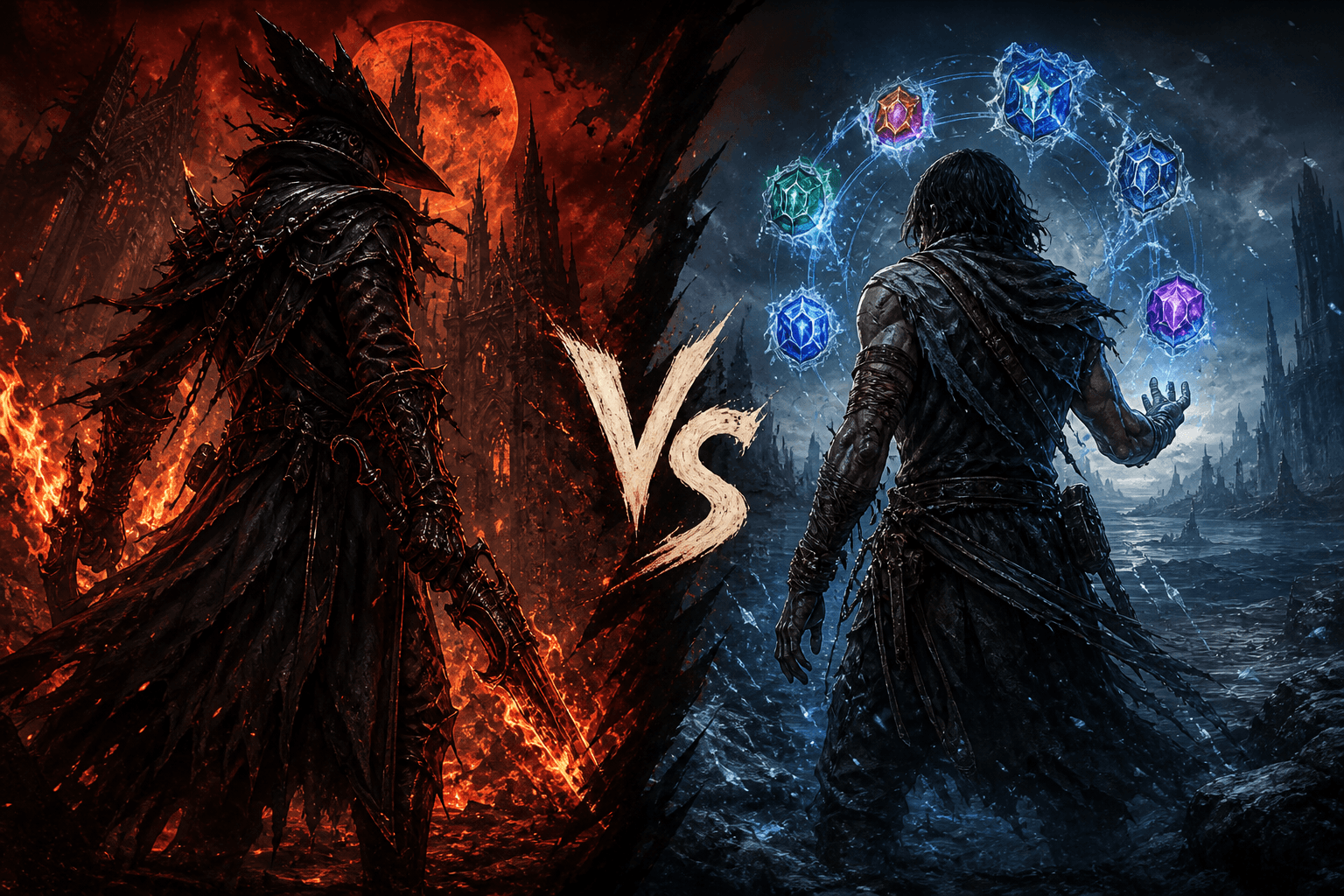
Play Diablo 4 if you want a polished, story-driven ARPG you can finish in 40-60 hours. Play Path of Exile 2 if you want a systems-deep game that rewards hundreds of hours per league. Casual players and first-time ARPG fans should pick D4 — onboarding is smoother and mechanics less punishing. Hardcore ARPG veterans, build-crafters, and players who value replayability should pick PoE2. If you play 5-15 hours per week, the honest answer is "play both" — D4 seasons and PoE2 leagues rotate on complementary cadences.
What Is the Difference Between Diablo 4 and Path of Exile 2?
Diablo 4 is Blizzard's $70 AAA live-service ARPG released in June 2023, with the Vessel of Hatred expansion launching October 2024. Path of Exile 2 is Grinding Gear Games' free-to-play ARPG with a six-act story, originally announced as a PoE1 update before being restructured into a standalone game. It entered Early Access in December 2024.
D4 is the accessible, mainstream-facing game — cinematic presentation, clean UI, and a seasonal "log in, play a new class, finish the season journey, log out" loop. PoE2 is the depth-first game — free to play with cosmetic-only microtransactions, driven by a three-to-four-month league cadence where each league introduces a major new mechanic and a fresh economy.
| Diablo 4 | Path of Exile 2 | |
|---|---|---|
| Developer | Blizzard Entertainment | Grinding Gear Games |
| Released | June 2023 (base), Oct 2024 (Vessel of Hatred) | December 2024 (Early Access) |
| Price | $70 base + $40 expansion | Free-to-play (cosmetics + stash tabs) |
| Platform | PC, PS5, PS4, Xbox Series X/S, Xbox One | PC, PS5, Xbox Series X/S |
| Cross-play / progression | Yes | Yes |
| Primary loop | Seasons (~3 months) + expansions | Leagues (~3-4 months) + economy resets |
| Player count style | Shared open world + parties up to 4 | Instanced hubs + parties up to 6 |
| Business model | Box + expansion + battle pass | Free-to-play with cosmetic MTX + stash |
Is Diablo 4 or PoE2 Better for Beginners?
Diablo 4 is absolutely the better beginner ARPG. Onboarding is deliberate and unintimidating — a clear campaign quest path, automatic stat tooltips that tell you what each affix does, an auto-loot filter that hides gray and white items by default, and a skill tree with maybe 40 meaningful choices across a character's lifetime. Teleport waypoints move you instantly, and every class has a clear core playstyle that works without spreadsheet research.
Path of Exile 2 is the opposite philosophy. The passive tree has 1,500+ nodes and a new player will stare at it for 20 minutes on first allocation. Currency items double as crafting materials — your "gold" drops are the same items you use to reroll affixes on rares. Skill gems slot into weapons with stat requirements, layered on support gem combinations that change how each skill functions. None of this is explained well in-game. PoE2 is better for someone who enjoys learning systems; D4 is better for someone who just wants to play.
Which Game Has Better Graphics?
Diablo 4 has the more polished overall engine. It runs on a bespoke Blizzard engine and the cinematics are on par with anything Blizzard has ever produced. The art direction is the "grimdark gothic horror" style that made Diablo 2 iconic, rendered at modern fidelity. Lighting, particle effects, and character model detail are all top-tier, and 4K HDR presentation on PS5 Pro or a modern PC looks genuinely stunning.
Path of Exile 2's graphics are a massive upgrade over PoE1 and competitive with D4 in many technical metrics — ragdoll physics, improved lighting, higher-fidelity character models, reworked environment art. The art direction is grittier, less "cinematic Hollywood," more "oppressive dark fantasy." PoE2's animation system — especially the dodge-roll and weapon-skill animations — is arguably more responsive than D4's. Technically, PoE2 has caught up. Presentationally, D4 is still more mainstream-appealing.
Which Has More Content?
Path of Exile 2 wins the content comparison decisively, measured in hours-per-season-or-league. A typical PoE2 league is 500+ hours for a dedicated player pushing one or two characters deep, and hardcore players easily hit 1,000+ hours across multiple builds. The content per league is enormous: six story acts, the Cruel difficulty campaign, the Atlas of Worlds endgame, pinnacle bosses, Ascendancy trials, and league-specific mechanics that add 50-100 hours on their own. D4's seasonal cycle is roughly 40-60 hours for the campaign on a new character plus 20-40 hours of seasonal journey and paragon grind.
Casual players who put 50 hours into a season will have a fine time in either game. Above 100 hours per season, PoE2 is dramatically more efficient content. A D4 player at 200 hours has seen essentially everything the current season offers; a PoE2 player at 200 hours is still discovering build interactions and pushing deeper into the Atlas.
| Content Dimension | Diablo 4 | Path of Exile 2 |
|---|---|---|
| Campaign length (first run) | 40-60 hours | 50-70 hours across Acts 1-6 (EA: ~30-40 hrs Acts 1-3) |
| Replay campaign for endgame? | No (skip after first char) | Optional; Cruel difficulty extends it |
| Endgame time investment (typical) | 40-80 hours per season | 300-500 hours per league |
| Unique items in pool | ~150+ uniques per class | ~500+ uniques total (growing each league) |
| Bosses at endgame | Uber Lilith, Duriel, Andariel, etc. | Pinnacle bosses + map bosses |
| Season/league cadence | ~3 months per season | ~3-4 months per league |
| Battle pass? | Yes ($10 per season) | No |
What Are the Classes in Diablo 4 vs PoE2?
Diablo 4 has five base classes — Barbarian, Druid, Necromancer, Rogue, and Sorcerer — plus the Spiritborn added in Vessel of Hatred. A Paladin-style holy warrior class has been rumored for the 2026 expansion cycle but is not confirmed. Each D4 class has a locked playstyle defined by its core resource (Fury, Spirit, Essence, Energy, Mana) and unique mechanic (Barbarian's arsenal, Druid's shapeshifting, Necromancer's Book of the Dead).
Path of Exile 2's launch class roster includes Warrior, Ranger, Witch, Monk, Mercenary, and Sorceress, with additional classes arriving through Early Access into 1.0. Each class has three Ascendancy subclasses unlocked through trial content. Crucially, PoE2's skill gem system is class-agnostic — any class can use any skill gem if it meets the stat requirements. A Ranger can run a fireball build, a Witch can dual-wield maces, a Monk can summon minions. The passive tree is shared across all classes, with each class starting in a different region of it.
| Game | Class List | Subclass System |
|---|---|---|
| Diablo 4 | Barbarian, Druid, Necromancer, Rogue, Sorcerer, Spiritborn | None (skill tree + paragon boards define build) |
| Path of Exile 2 | Warrior, Ranger, Witch, Monk, Mercenary, Sorceress (launch roster) | Ascendancy (3 subclasses per class via trials) |
How Do Endgame Systems Compare?
Diablo 4's endgame is structured around tier-gated activities. After the campaign you enter Torment I-IV, a difficulty ladder where each tier unlocks better gear. Nightmare Dungeons (NM1 through NM100) are the primary endgame loop — timed runs where higher tiers demand higher gear and grant more XP and Glyph progression. The Pit of the Artificers is the pure push content, a single infinite dungeon that scales to your limit. Infernal Hordes is a wave-survival mode. Uber bosses (Lilith, Duriel, Andariel) drop uber uniques.
Path of Exile 2's endgame is the Atlas of Worlds, a map-running system where each run consumes a Waystone, which you craft to increase difficulty and rewards. The Atlas has dozens of node types with different mechanics, and you spec into an Atlas passive tree that shapes what content you prefer. Pinnacle bosses — including the Arbiter of Ash, The Burning Monolith, and the Trialmaster — are gated behind specific Atlas progression and drop the rarest uniques. Ascendancy trials (Trial of the Sekhemas, Trial of Chaos) unlock and upgrade your Ascendancy class.
| Endgame Element | Diablo 4 | Path of Exile 2 |
|---|---|---|
| Core activity | Nightmare Dungeons, Pit of Artificers | Atlas of Worlds (Waystone maps) |
| Difficulty scaling | Torment I-IV + NM1-100 + Pit tier | Waystone tier (T1-T16+) + atlas modifiers |
| Pinnacle bosses | Uber Lilith, Duriel, Andariel, Tormented bosses | Arbiter of Ash, The Burning Monolith, Trialmaster |
| Build progression after max level | Paragon boards + Glyphs (NM dungeon leveled) | Jewels, Uniques, crafted gear, Atlas tree |
| Ascendancy/specialization | Paragon Board + Class Aspects | Ascendancy subclass via trials |
| Best-in-slot grind time | ~40-80 hours per season | ~200-500 hours per league |
Which Has Better Loot?
Diablo 4's loot is tiered and pacing-first. Items drop in Normal / Magic / Rare / Legendary / Ancestral Legendary / Unique rarities, with Legendary Aspects — extractable affixes that transfer from one item to another — as the signature system. Ancestral Legendaries (ilvl 800+ at Torment IV) are the endgame chase. Uniques are rare drops with fixed legendary powers. The D4 gear feel is "I got an upgrade this hour" — drops feel meaningful early and often.
Path of Exile 2's loot is item-modifier-driven and ceiling-first. Items roll with prefix and suffix modifiers — a rare can have up to six, and combinations of specific high-tier modifiers create items worth tens of exalted orbs on trade. PoE2 crafting uses currency items as consumables: Transmutation Orbs, Alchemy Orbs, Exalted Orbs, Divine Orbs, and others each modify items in specific ways. Perfect "mirror-tier" items can take weeks of currency farming to craft. Uniques in PoE2 often have complex build-enabling interactions rather than simple stat boosts.
Is PoE2 Really Free to Play?
Yes, Path of Exile 2 is genuinely free to play with no pay-to-win mechanics. Every microtransaction is either cosmetic (weapon effects, character skins, portal effects, pet cosmetics) or convenience (premium stash tabs, currency tabs, map tabs). GGG has maintained a strict "no P2W" policy across PoE1 for over a decade and has continued it in PoE2. You can complete every piece of content, reach every leaderboard, and participate in every league without spending a dollar.
That said, most serious PoE2 players spend something on stash tabs eventually. The default stash is small, and premium tabs (which allow public listing for trade) are close to mandatory for the trade league economy. A reasonable first purchase is around $20-$30 for a few premium tabs, currency tab, and map tab — a one-time investment that covers you across every league indefinitely. Compare that to Diablo 4's $70 base game plus $40 Vessel of Hatred expansion plus $10 battle pass per season, and PoE2 is dramatically cheaper over any reasonable time horizon.
| Cost Scenario | Diablo 4 | Path of Exile 2 |
|---|---|---|
| Year 1 minimum | $70 | $0 |
| Year 1 with expansion + 4 battle passes | $150 | $0-$30 (one-time stash) |
| Year 2 with next expansion + 4 passes | +$70-$80 | $0 (stash already owned) |
| Pay-to-win power advantage? | No | No |
| Free trial / demo available? | Limited trial periods | Entire game is free |
Which Is Better for Solo Play?
Diablo 4 is designed solo-first with optional co-op. The campaign is a single-player story, matchmaking into open-world zones is passive (you see other players but don't have to interact), and dungeon content can be run entirely solo at every difficulty. Endgame activities scale to solo play, and no content requires a group to complete. The one caveat: parties of 2-4 are faster for efficient seasonal progression, but nothing is gated behind grouping.
Path of Exile 2 is solo-friendly but has a distinct solo-self-found (SSF) mode for players who want total solo purity. SSF disables trading entirely and means you can only gear from your own drops, which is dramatically slower but appeals to a large hardcore solo community. Regular trade league PoE2 is very solo-friendly — most players solo 99% of their content — but gearing is significantly faster if you use the official trade site or third-party tools like poe.ninja to price-check items. Parties of 2-6 are available for content like Heist and bosses, but most builds prefer solo play for XP and loot efficiency.
How Does Seasonal Content Compare?
Diablo 4 runs roughly three-month seasons, each with a new themed mechanic (examples from past seasons include the Season of Blood vampiric powers and the Season of the Malignant infested corpses), new unique items tied to the mechanic, a season journey with cosmetic and XP rewards, and a $10 battle pass with premium cosmetic rewards. Seasons retire when the next one launches, and characters move to Eternal Realm. The seasonal mechanic is usually a temporary layer on top of the base game rather than a restructuring of systems.
Path of Exile 2's leagues run about three to four months, and each league launches with a major new mechanic that often changes how you approach the game fundamentally. PoE's league history — examples from PoE1 include Harvest (revolutionary crafting), Heist (stealth alternate game mode), Sanctum (roguelike trial gauntlet) — set the template for this, and PoE2 has continued it. Leagues reset the entire economy, create a fresh competitive race at launch, and the best leagues get integrated into the permanent game afterwards. No battle pass; cosmetics are sold a la carte.
Which Game Has Better Builds?
Path of Exile 2 has better builds, by a wide margin. The combination of the passive skill tree (1,500+ nodes), Ascendancy subclasses (3 per class with distinct mechanics), skill gem + support gem system (hundreds of skills each with dozens of supports that modify them), and item modifier combinations means thousands of viable builds exist per class. The most popular PoE2 builds are documented exhaustively on community sites, but the creative space is genuinely massive — you can build "Freezing Pulse Witch," "Minion Sorceress," "Poison Assassin," "Elemental Hit Ranger," dozens more, all of them distinct playstyles.
Diablo 4 has fewer viable builds by design. Each class has 4-6 meta builds per season, a few B-tier niche builds, and several "troll" builds that work but aren't competitive. The build variety is narrower because the skill tree is smaller, Legendary Aspects define most of your power budget, and Paragon Boards offer rotational power rather than structural changes. D4 builds are more polished and tuned — there's less chance of a "trap" build that wastes 100 hours — but the ceiling on creativity is much lower.
How to Choose Between D4 and PoE2 Step-by-Step
- Assess your time budget. If you have 3-10 hours per week, pick D4 — you'll finish a season feeling satisfied. If you have 15+ hours per week, pick PoE2 — you'll actually make it through a league's content.
- Consider complexity tolerance. If you enjoy learning complex systems (reading build guides, watching YouTube breakdowns, spending an hour on a passive tree), PoE2 rewards that. If you want to log in and play without research, D4 is friendlier.
- Decide on monetization. If budget is tight, PoE2 is $0 to try and $20-$30 one-time for stash tabs. D4 is $70 base plus $40 for the expansion plus $10 battle passes. Both give fair value for their price but the up-front cost is very different.
- Check your friends' preferences. ARPGs are more fun with a consistent group. If your friend group plays D4, that's probably where you should be. If they play PoE, same logic. Cross-game groups are possible but rare.
- Read a class guide from each game. Browse Maxroll for D4 classes and the PoE2 build guides on Maxroll or the PoE forums. Which class writeup gets you excited? That's your first character.
- Try the campaign of each if possible. PoE2's Acts 1-3 are available free in Early Access — try it with no commitment. D4 periodically has free trial weekends; grab one if available, or borrow from a friend.
- Commit to one game for a full season or league. You can't properly compare these games by playing 10 hours each. Commit to one full cycle (three months) before deciding. Most players who do this end up rotating between both over time anyway.
Should I Play Both?
Yes — and most serious ARPG players do. The two games' release cadences complement each other almost perfectly. D4 drops a new season roughly every three months; PoE2 drops a new league roughly every three to four months. They rarely overlap hard, and when they do, the strategy is to pick your main game for that cycle and casual-dip the other.
A reasonable rotation for a player with 10-15 hours per week: play D4 during expansion launches (Vessel of Hatred gave 40-60 hours of new content) and during a season if the seasonal mechanic looks appealing. Play PoE2 during league launches — the first three weeks of a PoE league are the most fun period in the entire ARPG genre, and you don't want to miss them. Outside those windows, play whatever catches your interest. Hardcore ARPG players often have active characters in both games at all times.
Account Buying for D4 and PoE2
Diablo 4 accounts have genuine resale value because the game is paid ($70 base plus $40 expansion) and because premium cosmetics, completed seasons, and unobtained battle pass items accumulate over time. Accounts with max-level characters across multiple classes, completed seasonal journeys, rare mount cosmetics from the Trader Tobin collection, and full Vessel of Hatred progress command higher prices than base accounts. If you're looking to buy or sell a D4 account, AccountShark's Diablo 4 marketplace lists current inventory.
Path of Exile 2 accounts are less commonly traded because the base game is free — anyone can create a new account at any time. The value exceptions are accounts with significant stash tab upgrades (players who have spent $50-$200 on premium tabs, currency tabs, and map tabs) and accounts with rare cosmetic microtransactions from older PoE events. These accounts exist on the secondary market but are a niche compared to paid-game markets like D4, WoW, and FFXIV.
Are These Games Played on PC Only?
No — both games are multi-platform. Diablo 4 launched with cross-platform support for PC, PlayStation 5, PlayStation 4, Xbox Series X/S, and Xbox One, and supports cross-play and cross-progression across all of them. Console-native controls are well-designed, and many players prefer the controller experience on Diablo 4's more deliberate combat.
Path of Exile 2 launched with support for PC, PlayStation 5, and Xbox Series X/S. PS4 and Xbox One are not supported — PoE2's engine demands current-generation hardware. Cross-play and cross-progression are enabled across the three supported platforms. Controller support is excellent, with a dedicated UI redesigned for gamepad rather than a simple port of the PC UI.
| Platform | Diablo 4 | Path of Exile 2 |
|---|---|---|
| PC (Windows) | Yes | Yes |
| PlayStation 5 | Yes | Yes |
| PlayStation 4 | Yes | No |
| Xbox Series X/S | Yes | Yes |
| Xbox One | Yes | No |
| Mac | No (native) | No (native) |
| Cross-play | Yes | Yes |
| Cross-progression | Yes | Yes |
FAQ
Is Path of Exile 2 Free? Yes, Path of Exile 2 is free to play with cosmetic-only microtransactions and optional premium stash tab upgrades. There are no pay-to-win mechanics and no content gated behind payment. A reasonable one-time investment of $20-$30 for stash tabs covers most players indefinitely across every league. You can play, complete the full campaign, reach endgame, and compete on leaderboards without spending a dollar.
Is Diablo 4 Worth Playing in 2026? Yes, Diablo 4 is worth playing in 2026, particularly if you own the Vessel of Hatred expansion (and later expansion content if you buy in during Season 14 / 15). The base game plus Vessel of Hatred is a 60-120 hour complete ARPG experience, and each new season adds another 40-60 hours of fresh content. If you're already bought in, seasons are a great reason to return. If you're a new buyer, waiting for a sale ($40-$50 for base plus expansion bundle is common during Blizzard promotions) is reasonable.
Which Game Has Better Endgame? Path of Exile 2 has the deeper endgame — the Atlas of Worlds, pinnacle bosses, Ascendancy trials, and crafted gear ceiling offer hundreds more hours of content per league than D4 offers per season. Diablo 4's endgame is more digestible; most players see everything in 40-80 hours per season. Pick PoE2 for endgame depth; pick D4 for endgame accessibility.
Can I Run D4 and PoE2 on the Same PC? Yes. Both games run on modern Windows hardware and neither has especially demanding minimum specs. D4 minimum is roughly a GTX 960 / RX 470 with 8GB RAM. PoE2 recommends similar mid-range hardware. On a PC that handles modern AAA games at 1080p medium settings, both games run comfortably. Storage is about 75GB for D4 and 60GB for PoE2.
Is PoE2 Too Hard for Casual Players? It depends on how you define "too hard." The base campaign is completable by casual players without deep research — you'll likely die more than in D4 and progression feels slower, but it's doable. The endgame is where PoE2 diverges from casual-friendly design. Maps, Atlas trees, crafting, and pinnacle bosses demand research and optimization in ways D4 does not. Casual players who play the campaign once and move on will have a fine time. Casual players who try to push endgame without reading guides will bounce off hard.
Which ARPG Has Better Builds? Path of Exile 2 has dramatically more build variety than Diablo 4. The passive tree plus skill gem plus Ascendancy system supports thousands of viable character builds, while D4's skill tree plus paragon plus legendary aspects system typically supports 4-6 meta builds per class per season. PoE2 is the clear winner for players who love theorycrafting and build variety.
How Long Does a D4 Season Last? A Diablo 4 season lasts approximately 12 weeks (three months), though exact duration varies by season. Seasons end with a transition period and a new season launches shortly after. Your seasonal character moves to the Eternal Realm at season end; your paragon progress and Legendary Aspect collection carry forward.
How Long Does a PoE2 League Last? A Path of Exile 2 league lasts approximately 13-16 weeks (three to four months), consistent with PoE1's league cadence. League characters move to the Standard league at league end, where they remain playable indefinitely. The best league mechanics often return in future leagues or get integrated permanently into the core game.
Should I Buy D4 or Wait for a Sale? Blizzard discounts Diablo 4 and its expansions aggressively. Base game regularly drops to $30-$40, and bundles with Vessel of Hatred have hit $50-$60 during major sales. If you're patient, waiting for a seasonal sale (Black Friday, summer sale, expansion anniversary) saves meaningful money. If you're ready to play a new season now, $70 for the complete current experience is reasonable but not discounted.
Can You Trade Items in D4? Diablo 4's trading system is limited compared to PoE2's full economy. D4 allows trading Rare and Legendary items (under certain rules) between players for gold, but uniques and ancestral legendaries are typically bind-on-pickup or bind-on-equip. There is no official trade website. Most players treat D4 as effectively a solo-loot game with minor trading at the margins. PoE2's full trade economy is the opposite — trading is central to the experience, with an official trade site, currency-based pricing, and billions of listings per league.
Final Verdict
Play Diablo 4 if you want a polished 40-60 hour ARPG you can finish in a month. Play Path of Exile 2 if you want a 500+ hour build-crafting ARPG you can live inside for a year. Both games are excellent at what they do. The wrong choice is picking one because a tier list said it's "better" — they're not better or worse than each other, they're built for different players. Honest advice: try D4 first if you've never played an ARPG, and migrate to PoE2 if you want more depth. Or play both on rotation, which is what most serious ARPG players end up doing anyway.
Buy or sell Diablo 4 accounts?
Browse available Diablo 4 accounts from screened sellers.