WoW Token Economics: How Gold Prices Shape Everything
Quick Answer / TL;DR: The WoW Token is Blizzard's official gold ↔ real-money bridge. As of early September 2026, Americas Retail Tokens trade near ~240k–280k gold (EU often higher, roughly ~350k–380k), so ~1 million gold is roughly $70–$80 of Token-equivalent value on NA at a ~$20 Token. That rate prices gold banks, boost quotes, and a slice of account valuations. Prefer Tokens during content lulls; expect spikes at expansion and major patch launches. Always check a live Blizzard-API tracker before you buy or sell.
The WoW Token is one of the most consequential additions to World of Warcraft's history. Introduced in 2015, this simple item — buy it with real money, sell it on the Auction House for gold, or buy it with gold for game time — created a bridge between WoW's in-game economy and real-world currency that affects everything from raid boost pricing to account values.
Understanding Token economics isn't just for gold goblins. It's essential context for anyone who participates in WoW's broader economy, whether you're buying gold, selling boosts, or evaluating accounts.
How the WoW Token Works
The basic mechanics are simple:
- Player A buys a WoW Token from the Blizzard Shop for $20 USD (Americas; EU and other regions use local fixed shop prices)
- Player A lists the Token on the Auction House
- Player B buys the Token with in-game gold (price fluctuates based on supply/demand)
- Player B redeems the Token for 30 days of game time or Battle.net Balance (commonly cited as $15 Balance on Americas — confirm in-client for your region)
Wowhead's Token item / guide pages and live trackers such as wowtokenprice.com show real-time and historical pricing. Classic Progression also has its own Token; do not mix Classic and Retail quotes when valuing a retail account's gold.
The Hidden Exchange Rate
Here's where it gets interesting. The Token creates an implicit exchange rate between gold and real currency:
Example — if a Token costs 250,000 gold and the shop price is $20:
- 250,000 gold = $20
- 1 gold ≈ $0.00008
- 1 million gold ≈ $80

Impact on Account Values
The Token exchange rate directly influences how people think about WoW account value.
Gold reserves on an account translate to real-world value through the Token rate. An account sitting on 10 million gold has roughly $650–$850 in "liquid" Token-equivalent value on NA at mid-2026 prices — before marketplace fees, transfer friction, or buyer discounts. Buyers rarely pay full Token parity for banked gold; expect a haircut versus pure Token math.
Gold-generating capabilities matter too. An account with a well-established crafting operation, multiple max-level characters for daily/weekly farming, and knowledge of gold-making strategies has ongoing earning potential that factors into valuation.
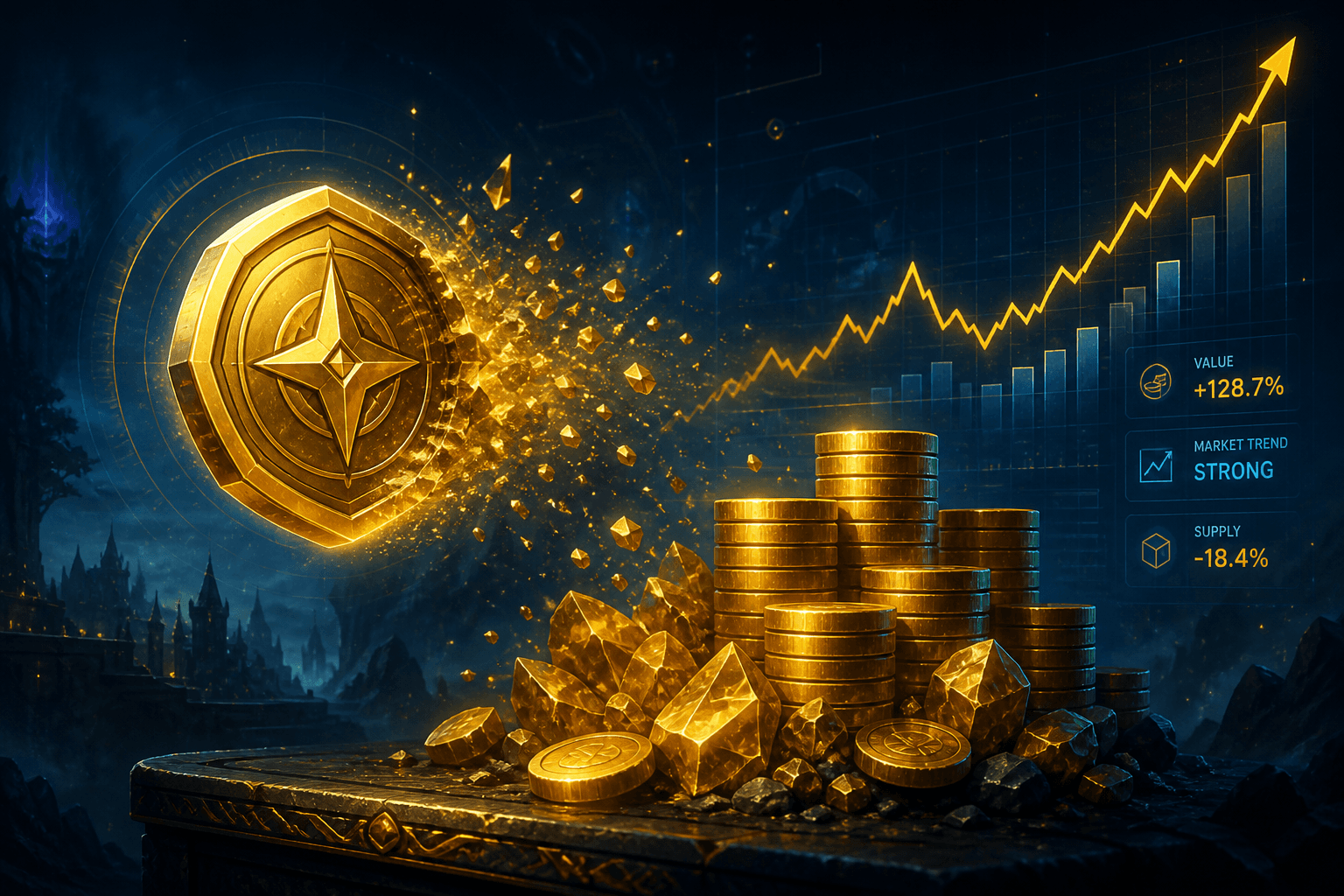
When Token prices spike (major content releases, mount FOMO, holiday events), the dollar value of a fixed gold pile temporarily drops — more gold per Token means each gold piece is "cheaper" in dollars. Spikes also usually mean more players are buying Tokens with cash, injecting gold into the economy.
Region Matters More Than Most Buyers Admit
Token markets are region-locked. Americas, Europe, Korea, and Taiwan each run independent prices. A EU Token at ~380k gold and a NA Token at ~250k gold are not interchangeable. When you compare account listings, convert gold using the buyer's region Token, not a global average. Cross-region "this account has 20M gold so it's worth $X" math fails if the character sits on a different Battle.net region than the buyer will play.
Impact on the Boost Market
WoW's boost market — players paying gold for Mythic+ runs, raid carries, and PvP rating — is directly tied to Token economics.
Boost pricing follows Token value. When the Token is worth ~250,000 gold, a Heroic raid carry quoted at "2 Tokens" is ~500,000 gold (~$40 shop-side). If the Token climbs to 350,000 gold, that same "2 Token" carry becomes 700,000 gold while the real-money intent stays similar.
This creates an interesting dynamic where boost communities effectively price services in "Tokens" rather than raw gold. A Mythic+ key might cost "1 Token" (one Token's worth of gold), regardless of what the actual gold number is. AccountShark's boost catalog is a useful parallel for players who prefer service pricing over raw gold quotes.
Token vs Third-Party Gold (High-Level)
Players often compare Tokens to third-party gold. Tokens are Blizzard-sanctioned, usually deliver almost instantly via the AH, and carry no ban risk from the purchase itself — but they are frequently worse gold-per-dollar than gray-market rates. Third-party gold can look cheaper and still expose accounts to recovery risk, phishing, and ToS enforcement. For a deeper side-by-side, see our Token vs third-party guide; for account valuation, the Token remains the cleanest public benchmark even when buyers ultimately choose a different path.
The Broader Gaming Economy Connection
The WoW Token's influence extends beyond WoW itself:
Cross-game spending: Token gold converted to Battle.net Balance can be spent on other Blizzard games — Diablo, Overwatch cosmetics, Hearthstone packs. WoW gold farming effectively generates currency for Blizzard's ecosystem (Balance redemption rules and eligible products can change — verify in the shop).
Market comparisons: Other games' economies are often discussed in WoW Token terms. "That OSRS item costs 2 billion GP, which is basically like 20 WoW Tokens" gives people an intuitive feel for value.
Account market pricing: When evaluating gaming accounts for purchase, the Token provides a reference point for the gold component of value. Sellers and buyers both use Token-equivalent pricing as a common language — then negotiate a discount for liquidity and risk.

Historical Token Price Movements
Token prices tell a story about WoW's health and player behavior:
- Expansion launches → Token prices spike as returning players buy gold for consumables, gear, and catch-up mechanics
- Content droughts → Prices drop as fewer players need gold and more are selling Tokens for game time
- FOMO events (limited-time mounts, BMAH items) → Sharp price increases as gold demand surges
- Economic patches (new gold sinks, crafting changes) → Prices adjust based on how the changes affect gold supply
- Midnight / housing-era demand → New sinks and cosmetics (including Decor-adjacent spending) can tug gold demand even outside traditional raid weeks

Smart Token Strategies
For gold makers:
- Buy Tokens when prices are low (content droughts) and sell/redeem them when prices are high (expansion launches)
- Track patch notes for upcoming gold sinks or gold-generating changes that will shift prices
- Watch regional charts — NA and EU can diverge for weeks
- Purchase Tokens during content droughts when your dollar buys more gold
- Avoid buying during the first week of expansion launches when prices are inflated
- If you need a fixed gold amount, compare live Token math to reputable alternatives without ignoring ToS risk
- Consider your gold reserves as part of your account's total value
- Large gold balances can be converted to Battle.net Balance before selling an account if desired (and if Balance is more useful to you than gold to a buyer)
- Document gold totals by character when listing — buyers price what they can verify
Risks and Misconceptions
- Token parity ≠ sale price. Marketplace buyers discount gold for friction, scams elsewhere in the market, and the fact that they could farm or Token themselves.
- Classic Token ≠ Retail Token. Mixing quotes warps Classic Era / MoP Classic valuations.
- "Gold will always go up." Token gold prices mean-revert around content cadence; multi-year all-time highs are not a reliable planning assumption.
- Balance ≠ cash-out. Redeeming a Token for Battle.net Balance does not mean Blizzard will cut you a check — Balance is spendable inside Blizzard's ecosystem under their rules.
The Ethical Dimension
The Token exists in an interesting ethical space. It's officially sanctioned RMT (real-money trading) from Blizzard — something that would get you banned if done through unauthorized third-party sites. Blizzard's argument is that the Token provides a safe, regulated way for players to exchange money for gold, reducing fraud and account compromise from sketchy gold-selling operations.
Critics argue it's pay-to-win — that wealthy players can buy their way to competitive gear through gold → boost purchases. Supporters counter that the gold comes from other players (not thin air), and that boosts require the boosted content to actually be completed by skilled players.
The debate continues, but the Token's impact on WoW's economy is undeniable.
FAQ: WoW Token Prices, Gold Value, and Account Worth
How much is the WoW Token worth in gold right now in 2026? There is no single permanent number. As of early September 2026, Americas Retail live prints have been roughly in the ~240k–280k gold band and Europe often higher (~350k–380k+), but the Blizzard API updates frequently. Check wowtokenprice.com or the in-game Auction House price for your region before any large decision. Classic Progression Tokens are a separate market with their own gold levels.
How do WoW Token economics affect gaming account market prices? Buyers convert banked gold into a rough dollar figure using Token rates, then discount for fees and risk. An account with 10 million gold is not automatically "worth" ten million ÷ Token price in cash — but Token math still anchors negotiations for the liquid portion of the listing. Rare mounts, transmog, ratings, and housing Decor collections usually dwarf gold in long-term account value; gold is the easy part to price.
Is buying a WoW Token safer than buying third-party gold? Yes for ToS and delivery risk: Tokens are Blizzard's official channel. Third-party gold can be cheaper per gold but introduces ban, recovery, and scam risk. Safety and price pull in opposite directions; pick based on your risk tolerance, not only the spreadsheet.
Should I convert gold to Battle.net Balance before selling my WoW account? Sometimes. If Balance helps you more than it helps a buyer (or if you want to strip liquid value before transfer), redeeming Tokens can make sense. If buyers specifically want a gold-ready account for crafting, boosting, or housing purchases, leaving gold in-game may support a cleaner listing. Run the Token math both ways before you decide.
Why did the WoW Token price spike after an expansion or Midnight patch? Returning and new players flood gold demand for enchants, crafts, carries, and catch-up — while Token supply cannot instantly match. Prices rise until more cash buyers list Tokens or gold demand cools. The reverse happens in droughts: more players buy game time with gold, and fewer people need massive gold piles.
Conclusion
The WoW Token is more than a convenience item. It's the foundation of WoW's modern economy, a bridge between virtual and real-world value, and a lens through which millions of players evaluate everything from mount prices to account worth.
Understanding Token economics won't make you rich overnight. But it will help you make smarter decisions about gold, accounts, and how you spend your time in Azeroth.
For players looking to skip the gold grind and jump into WoW with an established account, AccountShark's WoW listings include gold balance information and notable assets for every listing.
Ready to skip the grind? Browse WoW accounts with established characters, gold reserves, and leveled professions.
Buy or sell World of Warcraft accounts?
Browse available World of Warcraft accounts from screened sellers.