The standard PlayStation 5 is getting the kind of image-quality upgrade that used to be reserved for the PS5 Pro. On November 13, 2026, Sony named the next wave of games adopting Quick Spectral Super Resolution (QSSR), its AI-guided upscaler for the base console. Marvel's Spider-Man 2 has it now, Control Resonant gets it in December, and Arc Raiders, The Finals, No Man's Sky and Hell Let Loose: Vietnam are lined up for updates over the coming weeks.
QSSR first appeared on October 1 in Marvel's Wolverine and Ghost of Yōtei. With six more titles now attached, it is turning from a two-game showcase into a real feature of the platform. This guide explains what QSSR is, how it differs from PSSR on PS5 Pro, which games support it today, which are still waiting, what it costs in performance, and what PS5 owners should expect next.
What Is QSSR on PS5?
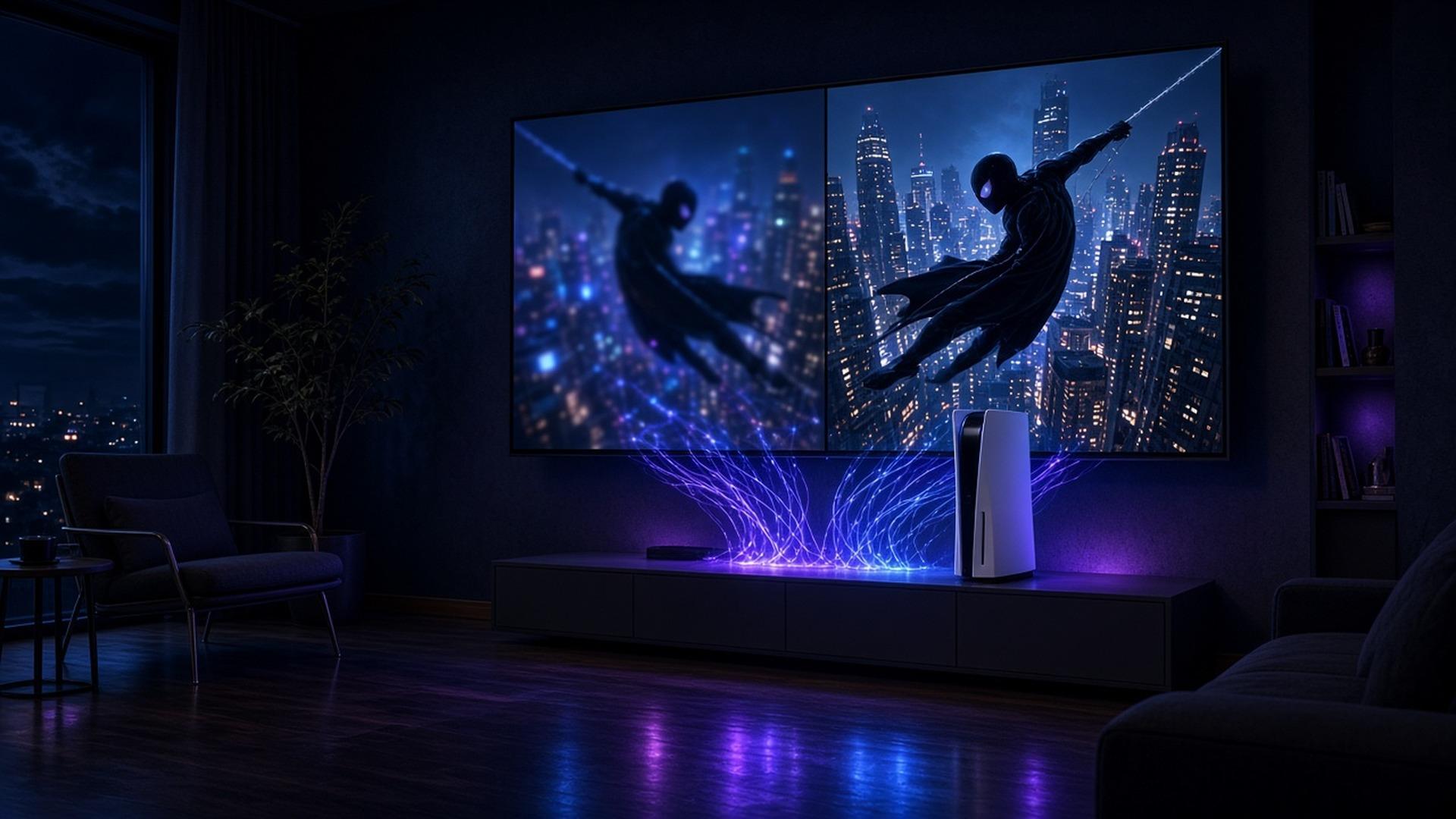
Quick Spectral Super Resolution is an AI upscaler built for the original PS5 and the PS5 Digital Edition. Like any upscaler, it lets a game render each frame at a lower internal resolution and then reconstruct a sharper, higher-resolution image for your TV. The difference is how that reconstruction happens. Traditional methods rely on hand-written rules to combine information from previous frames. QSSR uses a trained neural network to decide, pixel by pixel, how to rebuild detail and how to keep the picture stable from one frame to the next.
Sony introduced QSSR in an October 1 PlayStation Blog post from Daniel Craig, Principal Engineer for Graphics R&D at Sony Interactive Entertainment. The post describes QSSR as "a new performance tier of AI upscaling" and credits two changes for making it possible on the base console:
- A streamlined neural network architecture, smaller and cheaper to run than the model used on PS5 Pro.
- A hand-tuned implementation written to squeeze the most performance out of standard PS5 hardware.
Both technologies come out of Project Amethyst, Sony's graphics research partnership with AMD. That same collaboration produced the upgraded PSSR on PS5 Pro and has fed into AMD's machine-learning graphics work on PC.
QSSR vs PSSR: What Is the Difference?
The names are close because the technologies are related, but they target very different hardware.
PSSR (PlayStation Spectral Super Resolution) runs on the PS5 Pro, which includes dedicated machine-learning hardware. In an interview with Digital Foundry, Craig pointed out that the Pro has "300 TOPS of dedicated hardware for this purpose" and can therefore pick "a much more generous spot on that cost-versus-quality curve." PSSR relies on INT8 instructions that the base PS5 does not support.
QSSR runs on the standard PS5, which has no dedicated AI silicon. According to Craig, it "relies primarily on FP16 math," with extensive use of packed math instructions and other low-level optimizations to keep the GPU busy and amortize costs. In practical terms, QSSR is a smaller, faster model built to run on the regular graphics hardware rather than on purpose-built AI units.
That distinction matters for expectations. QSSR does not turn a base PS5 into a PS5 Pro. The Pro still renders games at higher internal resolutions, outputs to higher resolutions, and runs a heavier, higher-quality model. What QSSR does is raise the floor on the base console, where many games have leaned on FSR 2, FSR 3 or basic temporal anti-aliasing to stretch low internal resolutions up to 1440p or 4K.
| Feature | QSSR | PSSR |
|---|---|---|
| Console | Standard PS5 and PS5 Digital Edition | PS5 Pro |
| Hardware used | Regular GPU, mostly FP16 math | Dedicated ML hardware, INT8 math |
| Model size | Streamlined, built for lower cost | Larger, higher-quality model |
| First available | October 1, 2026 | PS5 Pro launch, with an upgraded version in 2026 |
| System-wide override | None announced; added game by game | Enhance PSSR Image Quality setting for PSSR games |
| Developer integration | Shares PSSR's interface; close to drop-in for PSSR titles | Requires a PS5 Pro enhanced patch |
Which PS5 Games Support QSSR?
Here is the full list of games Sony has tied to QSSR so far, with their current status as of November 15, 2026.
| Game | Developer | QSSR status |
|---|---|---|
| Marvel's Wolverine | Insomniac Games | Live since October 1 |
| Ghost of Yōtei | Sucker Punch Productions | Live since October 1 |
| Marvel's Spider-Man 2 | Insomniac Games | Live since November 13, Fidelity and Performance modes |
| Control Resonant | Remedy Entertainment | Update coming in December |
| Arc Raiders | Embark Studios | Coming soon, no date |
| The Finals | Embark Studios | Coming soon, no date |
| No Man's Sky | Hello Games | Expected in the next few weeks |
| Hell Let Loose: Vietnam | Expression Games | Upcoming update, no date |
The November announcement came in a second PlayStation Blog post, QSSR arrives in Marvel's Spider-Man 2, Control Resonant, The Finals, Arc Raiders, No Man's Sky, and Hell Let Loose: Vietnam, which collects statements from each studio. Sony describes the updates as "rolling out over the coming weeks" and expects to bring QSSR "to more games on PS5 in the coming months."
Game-by-Game: What Each QSSR Update Brings
Marvel's Wolverine
Wolverine, which launched on September 15, 2026, was one of the two launch titles for QSSR and remains its strongest showcase. Insomniac's Mike Fitzgerald described the result as "more pixel-level clarity and stability" across locations such as Madripoor and Shinjuku, and called it "a great taste of the PS5 Pro experience" for base PS5 owners.
Digital Foundry's hands-on testing backs that up. In its comparisons, temporal stability improved substantially, sub-pixel detail such as thin lines and hair held together much better, and ghosting on moving foliage was greatly reduced. The outlet called the quality boost in Wolverine "exceptional," noting that output detail looked higher even when dynamic resolution dropped the internal resolution to make room for QSSR.
Before QSSR, Digital Foundry's review measured the base PS5's performance mode at roughly 1296p and fidelity mode at around 1800p, using Insomniac's own temporal upscaler.
Ghost of Yōtei
Sucker Punch added QSSR to Ghost of Yōtei on the same day. Lead Rendering Engineer Jasmin Patry highlighted its handling of fine character and environment detail "with a level of temporal stability that hasn't been possible on the PS5 console until now."
The gains here are smaller than in Wolverine because Ghost of Yōtei already had decent image quality. Digital Foundry found the improvement "less dramatic," but it also found that QSSR ran at almost the same frame rate as the game's existing FSR 3 implementation in an uncapped performance test. If that holds across more games, QSSR could be close to a free upgrade over FSR 3 for many PS5 titles.
Marvel's Spider-Man 2
Spider-Man 2 leads the new wave, and at three years old it is the oldest game to receive QSSR so far. The update is live now and covers both Fidelity and Performance modes. Insomniac decided to bring it to its 2023 game after seeing the results in Wolverine, which runs on the same Insomniac Engine.
This is an interesting test case. Spider-Man 2's New York is far larger and more open than Wolverine's environments, with fast traversal that tends to expose shimmering and instability in upscaled images. Swinging at speed past thin railings, cables and building edges is exactly the kind of content where a stable reconstruction makes the biggest visible difference.
Control Resonant
Remedy's Control Resonant launched on PS5 on September 24, 2026, and its QSSR update is scheduled for December. Senior Graphics Programmer Erik Jansson said QSSR gives the game "a much more stable and detailed image," and called it "the same kind of leap on the PS5 that PSSR brought to PS5 Pro."
Remedy's games are known for dense effects, particles and sharp geometric architecture, all of which are hard on traditional upscalers. Digital Foundry pointed out that Control Resonant's performance mode can show aliasing and artifacts on base PS5, so this update has more room to make a visible difference than most.
Arc Raiders and The Finals
Embark Studios is adding QSSR to both of its PlayStation games. Technical Art Director Mikael Linderholm said the update will bring "increased sharpness, better environmental clarity and overall visual improvements." No date has been announced beyond "coming soon."
For competitive shooters, image stability is more than cosmetic. Cleaner edges and less shimmer at distance can make it easier to read movement and silhouettes against busy backgrounds. Both games already prioritize high frame rates, so how Embark balances QSSR's cost against performance targets will be worth watching when the updates arrive.
No Man's Sky
Hello Games founder Sean Murray framed QSSR around the game's procedural universe, where "every star in the night sky is a real solar system," and said the team cares "a great deal about the quality of every pixel." He described QSSR as a way to render the universe in "sharper, cleaner and more beautiful detail, while delivering the best possible framerate." The update is expected "in the next few weeks."
Hell Let Loose: Vietnam
Expression Games will add QSSR to Hell Let Loose: Vietnam, which launched on PS5 on August 13, 2026. Game Director Paul Rustchynsky said console visuals are something the community "has been passionate about" and promised sharper, cleaner image quality "from dense jungle to the chaos of a full-scale firefight."
This may be the update with the most to gain. The game's PS5 image quality drew heavy criticism at launch, and Digital Foundry singled it out as the title where QSSR could deliver "a significant upgrade," with the caveat that it may require a slightly lower base resolution. Dense jungle foliage is a classic weak spot for traditional upscalers, which tend to produce shimmering and smeared detail in exactly that kind of scene.
How Much Performance Does QSSR Cost?
No upscaler is free, and QSSR is no exception. Digital Foundry measured its cost in Marvel's Wolverine by running the game uncapped with VRR and switching QSSR on and off:
- 1440p output (upscaling from 864p): QSSR was about 1.5 to 1.8 milliseconds per frame slower than Insomniac's own upscaler, roughly an 8 to 10 fps difference with the frame rate unlocked.
- 4K output in fidelity mode: the cost rose to about 4.4 milliseconds per frame, far higher than PSSR's roughly 2ms on PS5 Pro.
The 4K result explains why 1440p is the natural target for QSSR. Many base PS5 games already output at around 1440p in their performance modes, which is where QSSR is both affordable and most effective. Craig agreed with that assessment, explaining that developers on PS5 "have to be more flexible, tuning not just render resolution, but also their intermediate and final presentation targets depending on the graphics mode."
In Ghost of Yōtei, the uncapped performance test showed QSSR running almost identically to FSR 3. That is only one game, and resolutions were not matched precisely, but it suggests the cost varies a lot depending on what each game was using before.
How to Use QSSR on Your PS5
QSSR works differently from PSSR on PS5 Pro, so a few practical points help:
- Update the game. QSSR arrives through individual game patches. Keep automatic updates on or check for updates manually on supported titles.
- Check the graphics menu. Sony describes QSSR as an additional graphics option in the launch titles. Menu wording and default behavior are set by each developer, so look in each game's display or graphics settings.
- No system toggle. Sony has not announced a console-level QSSR switch. On PS5 Pro, the Enhance PSSR Image Quality option under Settings, Screen and Video, Video Output only affects games that already support PSSR, and nothing equivalent exists for QSSR on base PS5.
- Mode support varies. Spider-Man 2 supports QSSR in both Fidelity and Performance modes. Other games may limit it to certain modes depending on how much headroom they have.
- Expect resolution trade-offs. If a game uses dynamic resolution, its internal resolution may drop slightly with QSSR enabled. That is normal and usually results in a better-looking image overall.
What About PS5 Pro Owners?
PS5 Pro owners keep using PSSR, not QSSR. The Pro has had its own upgrade this year. An enhanced version of PSSR arrived in March, and system software 26.06-14.00.00 in September made the Enhance PSSR Image Quality setting the default, as Engadget reported. Games built on the original PSSR now use the newer model automatically, though the override can be turned off if a particular game shows unexpected artifacts.
QSSR may still help Pro owners indirectly. Because QSSR shares its interface with PSSR, studios that already support PSSR on Pro have a short path to supporting QSSR on base PS5. Craig described it as "fundamentally a drop-in replacement for titles that already support PSSR," though tuning settings such as texture streaming can take "a few days." The reverse is also true: games authored with both upscalers in mind from the start should treat high-quality AI upscaling as a baseline across the whole PS5 family.
Why QSSR Matters for the PS5 Generation
The PS5 is six years into its life, and one of the biggest weaknesses of the generation has been image quality. Many demanding games run at low internal resolutions, sometimes near 720p, and rely on FSR 2, FSR 3 or TAA to scale up to 1440p or 4K. The result is often a soft, shimmering image, especially in motion, on foliage, and around thin geometry.
QSSR targets exactly that problem without asking players to buy new hardware. It also changes the value calculation around the PS5 Pro. Sony's answer, both in the PlayStation Blog posts and in Craig's comments, is that the Pro remains clearly ahead: it can render at higher base resolutions, output at higher resolutions, and run a heavier model on dedicated hardware. QSSR narrows the gap in stability and clarity, but it does not close it.
There is also a developer angle. Sony states that QSSR "will be offered broadly to all PlayStation developers," and Craig called retrofits "relatively easy and low risk." That points to a steady stream of patches for existing games, not only new releases.
Will GTA 6 Use QSSR?
Grand Theft Auto VI launches on November 19, 2026, and it is natural to wonder whether it will use QSSR on base PS5 or PSSR on PS5 Pro. Neither Rockstar nor Sony has announced QSSR support for GTA 6. Digital Foundry noted that the tools are available and that the decision rests with Rockstar. For now, treat any claims about QSSR in GTA 6 as unverified until Rockstar or Sony announces them.
What to Watch Next
- Arrival dates for the Arc Raiders, The Finals, No Man's Sky and Hell Let Loose: Vietnam updates, all expected within weeks.
- Control Resonant's December patch, likely the clearest test of QSSR on a game with known artifact problems in performance mode.
- New announcements. Sony has said more games will follow in the coming months, and studios with existing PSSR support are the most likely candidates.
- Independent analysis of Spider-Man 2's open world, which will show how QSSR handles fast traversal over a large, detailed city.
Frequently Asked Questions
What does QSSR stand for on PS5?
QSSR stands for Quick Spectral Super Resolution. It is Sony's machine-learning upscaler for the standard PS5, introduced on October 1, 2026, and built from the same Project Amethyst research with AMD that produced PSSR on PS5 Pro.
Is QSSR the same as PSSR?
No. They are related, but PSSR runs on the PS5 Pro's dedicated machine-learning hardware using INT8 math and a larger model. QSSR uses a streamlined neural network that runs mainly on FP16 math on the standard PS5's GPU. PSSR still delivers higher image quality, while QSSR is designed to improve the base console's image quality at a cost it can afford.
Which games support QSSR right now?
As of November 15, 2026, QSSR is live in Marvel's Wolverine, Ghost of Yōtei and Marvel's Spider-Man 2. Control Resonant receives it in December, and Arc Raiders, The Finals, No Man's Sky and Hell Let Loose: Vietnam are due in upcoming updates without specific dates.
Do I need a PS5 Pro for QSSR?
No. QSSR is designed for the standard PS5 and the PS5 Digital Edition. PS5 Pro owners continue to use PSSR, which is the higher-quality option on that console.
How do I turn on QSSR?
Update a supported game to its latest version and check its graphics or display settings. Sony describes QSSR as an additional graphics option in supported games, and each developer decides how it is labeled and whether it is on by default. There is no system-wide QSSR setting.
Does QSSR lower performance?
It has a cost. Digital Foundry measured about 1.5 to 1.8 milliseconds per frame in Marvel's Wolverine when upscaling to 1440p, and about 4.4 milliseconds at 4K. In games with dynamic resolution and a 60fps target, the frame rate usually stays the same while the internal resolution drops slightly, and the final image still looks noticeably better.
Is QSSR better than FSR 3?
In the games tested so far, QSSR delivers better image stability, cleaner fine detail and less ghosting than traditional upscalers like FSR 3 and TAA. In Ghost of Yōtei it also ran at nearly the same frame rate as FSR 3, though results will vary by game.
Will more PS5 games get QSSR?
Yes. Sony plans to offer QSSR broadly to PlayStation developers and expects more games to adopt it in the coming months. Titles that already support PSSR on PS5 Pro are the easiest to update, because QSSR shares the same interface.
Will GTA 6 support QSSR?
There is no announcement of QSSR support for Grand Theft Auto VI. The game launches November 19, 2026, and whether it uses QSSR or PSSR is up to Rockstar.
Buy or sell ARC Raiders accounts?
Browse available ARC Raiders accounts from screened sellers.