Is Buying WoW Gold Safe in 2026? What You Need to Know
Quick answer: Buying WoW gold from third parties violates Blizzard's EULA. The only fully sanctioned cash-to-gold path is the WoW Token (~$20 USD in North America; gold payout floats by region). As of early September 2026, US retail Tokens were trading around ~240k–260k gold and EU around ~350k–400k gold. Individual buyers are usually a lower enforcement priority than bot farms and RMT sellers, but risk is not zero — especially with stolen/duped gold. Reputable sellers + reasonable amounts + 2FA still matter.
"Will I get banned?" That is the first question most players ask before buying gold from a third-party seller. You have mounts, transmog, characters, and years of progress on the line. This guide covers Blizzard's written rules, how enforcement tends to work in practice, real risks beyond the ban hammer, and how to reduce exposure if you still choose to buy.
Blizzard's Official Stance
According to the Blizzard End User License Agreement, players may not exploit the platform for unauthorized commercial uses — including gathering in-game currency, items, or resources for sale outside Blizzard's systems, and performing paid in-game services. Buying or selling gold outside the WoW Token system falls outside what Blizzard authorizes.
That is the policy. Practice is more nuanced — but "nuanced" does not mean "allowed."
What Actually Happens: Enforcement Reality
Blizzard's enforcement resources are finite. They allocate them by impact.
Where Blizzard Focuses Enforcement
- Bot operators and gold farmers — Automated farming at scale damages the economy and player experience
- Large-scale RMT operations — Organized rings processing huge volumes
- Account sellers / account-sharing services — Adjacent category that still draws heavy attention
- Exploiters and cheaters — Dupes, speed hacks, and other game-breaking abuse
Where Enforcement Is Lower (Not Zero)
Individual gold buyers are consistently a lower priority than sellers and botters. Blizzard has run buyer-targeted actions at points in WoW's history — early ban waves and periodic exploit-driven sweeps — but those events are less frequent than supply-side bans. Most casual buyers are not swept up every patch.
When buyer actions do happen, community reports often look like:
- First offense: Warning or short suspension (24–72 hours)
- Repeated / large-volume buying: Longer suspension
- Permanent bans for buying alone: Rare compared with seller/bot bans — but Blizzard has warned that participating in gold-seller transactions can lead to gold removal and account suspension, including permanent action in serious cases
Why Buyers Are Lower Priority
Banning buyers does not remove the bot farm that supplied them. Supply-side takedowns produce more game-health ROI. Gold buyers are also often paying subscribers and shop customers — mass-banning demand is bad business. None of that is a promise you are safe.
The WoW Token Factor
The WoW Token (launched 2015) is Blizzard's official channel for converting real money into gold (and gold into game time / Battle.net Balance).
What the Token acknowledges in practice:
- Demand for cash-to-gold exists
- A sanctioned market is preferable to ignoring RMT entirely
- Buying gold as a concept is not treated as automatically game-breaking when it goes through Blizzard
| Region | Shop price (typical) | Approx. AH gold price | Rough gold per $1 | |---|---|---|---| | US Retail | $20 USD | ~240k–260k gold | ~12k–13k gold/$ | | EU Retail | €20 EUR | ~350k–400k gold | varies with FX | | Redeem (gold →) | — | 30 days game time or ~$15 USD Battle.net Balance | — |
Prices refresh frequently. Always check the in-game Token price the day you buy.
The Token's existence has not legalized third-party gold. It has shifted a chunk of demand into a monitored, sanctioned pipe — while third-party buying remains a ToS/EULA risk.
Real Risks You Should Know About
Ban risk is only one lane.
1. Compromised Gold Sources
The ugliest failures are about where the gold came from:
- Hacked accounts — Stolen gold can be traced and reversed
- Credit card fraud — Chargeback chains can trigger investigations
- Bug exploits / dupes — Flagged gold gets removed; buyers can end negative
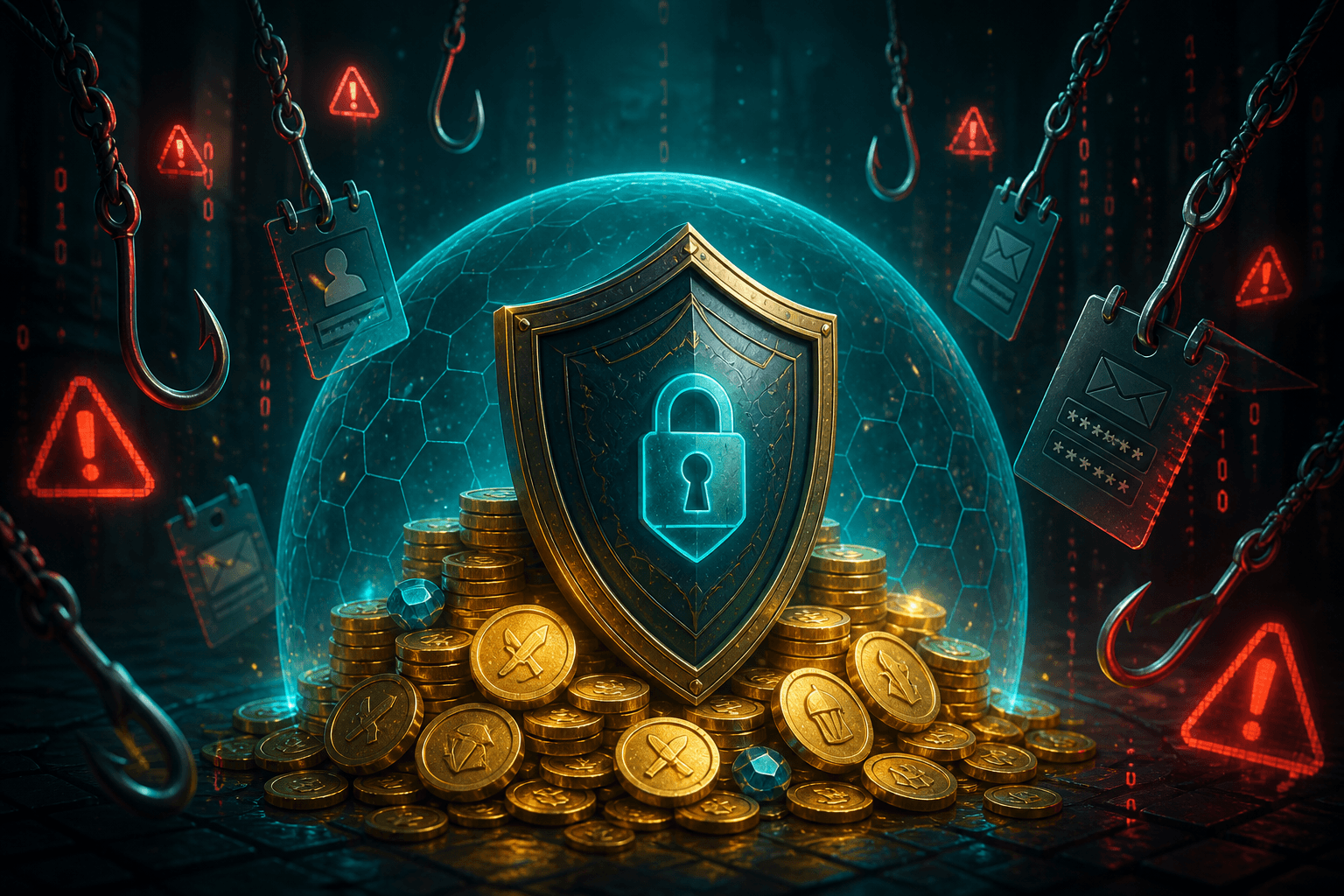
2. Phishing and Scams
- Fake seller sites that take payment and disappear
- Sellers who demand your Battle.net login (instant dealbreaker)
- Bait-and-switch pricing at checkout
- Fake Discord "support" channels
3. Payment Security
- HTTPS and recognizable processors (PayPal, Stripe, major cards)
- Clear refund / redelivery policy
- Avoid irreversible payment methods on a first order with an unknown seller
How Reputable Sellers Operate
Sourcing
- Organized farming by real players
- Buying surplus gold from other players
- Cross-realm economic play inside game systems
- Sometimes Token market-making as part of a larger pipeline
Delivery Methods
- Face-to-face trade — Most common and usually cleanest UX
- Auction House method — You list a cheap item; seller buys it (AH cut applies)
- Mail — Less common; easier to pattern-match in some eras
Red Flags That Signal an Unsafe Seller
- No independent reviews
- Prices far below market
- Requests for account login
- High-pressure countdown tactics
- No support channel
- Crypto-only with no buyer protection and no reputation
How to Protect Your Account
Before the Purchase
- Research the seller on independent review sources
- Confirm delivery method before paying
- Use a payment method with dispute rights for first purchases
During the Transaction
- Buy amounts that fit your character's wealth history — split huge orders
- Do not discuss RMT in public chat channels
- Receive gold, then spend it naturally over time
After the Purchase
- Save order confirmations
- Watch for unusual logins or missing items
- Keep Battle.net 2FA enabled — everyone should, gold buyer or not
The Numbers: What Does Enforcement Actually Look Like?
Blizzard does not publish tidy buyer-ban dashboards. Community tracking over two decades shows:
- Major bot ban waves every so often, sometimes huge — overwhelmingly bots/farmers
- RMT site pressure via legal and operational disruption — seller-side
- Buyer actions that usually involve huge volumes, repeat offenses after warnings, or gold tied to compromised accounts
Gold Buying in WoW Culture (2026)
Gold buying has existed since Vanilla. Early enforcement was harsher in tone; the Token normalized sanctioned cash-to-gold. In 2026, a large share of the player base has used either Tokens or third-party gold at some point. Cultural normalization still does not rewrite the EULA.
Token vs Third-Party: Safety Snapshot
| Factor | WoW Token | Third-party gold | |---|---|---| | Rules status | Fully allowed | Against EULA / unsupported | | Ban risk from the purchase itself | None | Low for small buyer volumes, not zero | | Gold reversal risk | None | Real if supply is dirty | | Cost efficiency | Worse gold per dollar lately | Usually better gold per dollar | | Speed | Seconds to minutes | Minutes to hours |
If your priority is absolute account safety, buy Tokens. If your priority is gold-per-dollar, third-party is cheaper and riskier — details in our Token vs third-party comparison.
Frequently Asked Questions
Is buying WoW gold safe in 2026? "Safe" depends on what you mean. The WoW Token is safe from a rules perspective. Third-party gold is against Blizzard's EULA and can lead to warnings, suspensions, gold removal, or — in serious or repeat cases — heavier action. Many individual buyers never see enforcement, especially at modest volumes from cleaner sources, but the activity is still unsupported and risky if the gold is stolen, duped, or tied to a busted RMT ring.
Can Blizzard detect third-party WoW gold purchases? Blizzard monitors unusual gold flows, links to flagged farmers, and patterns that match known RMT pipelines. A single mid-sized face-to-face trade can look like ordinary player commerce; repeated huge injections from brand-new characters are louder. Detection is not guaranteed for every purchase and not impossible either.
What happens if I get caught buying WoW gold? Community reports for first-time buyers often describe warnings or short suspensions, especially when volume is limited. Gold sourced from compromised accounts is more likely to be removed and to create secondary headaches. Permanent bans for buying alone are less common than seller/bot bans, but Blizzard has publicly warned that gold-seller transactions can lead to permanent suspension.
Is the WoW Token safer than buying gold from websites? Yes. The Token is Blizzard's own system — no EULA violation for using it as designed. The trade-off is price: at ~$20 for roughly 240k–260k US gold in early September 2026 snapshots, Tokens usually deliver less gold per dollar than reputable third-party rates.
How much WoW gold can I safely buy at once? There is no published safe number. Proportional purchases that look like normal progression wealth are quieter than receiving many times your net worth in one hit. Spreading large needs across multiple deliveries is common risk hygiene. Exact thresholds are unknown because Blizzard does not publish them.
Does buying WoW gold affect my Battle.net account security? The purchase itself is a policy risk; the bigger security failures happen when sellers phish logins, send malware "delivery tools," or convince you to disable 2FA. Never share Battle.net credentials. Keep authenticator app 2FA on, and treat any seller asking for login access as a scam.
The Bottom Line
Buying WoW gold in 2026 is lower risk for careful individual buyers than headlines imply — and still against the rules. Enforcement concentrates on bots, farmers, and RMT supply. The Token remains the zero-rules-risk option. If you use a third party, seller quality matters more than almost any other variable: clean supply, clear delivery, and real support turn a stressful purchase into a routine one.
---
Need WoW gold from a source you can trust? Check out AccountShark's WoW gold offerings — safe, fast delivery and customer-focused support.
Ready to skip the grind? Browse WoW accounts with established characters, gold reserves, and leveled professions.
Buy or sell World of Warcraft accounts?
Browse available World of Warcraft accounts from screened sellers.