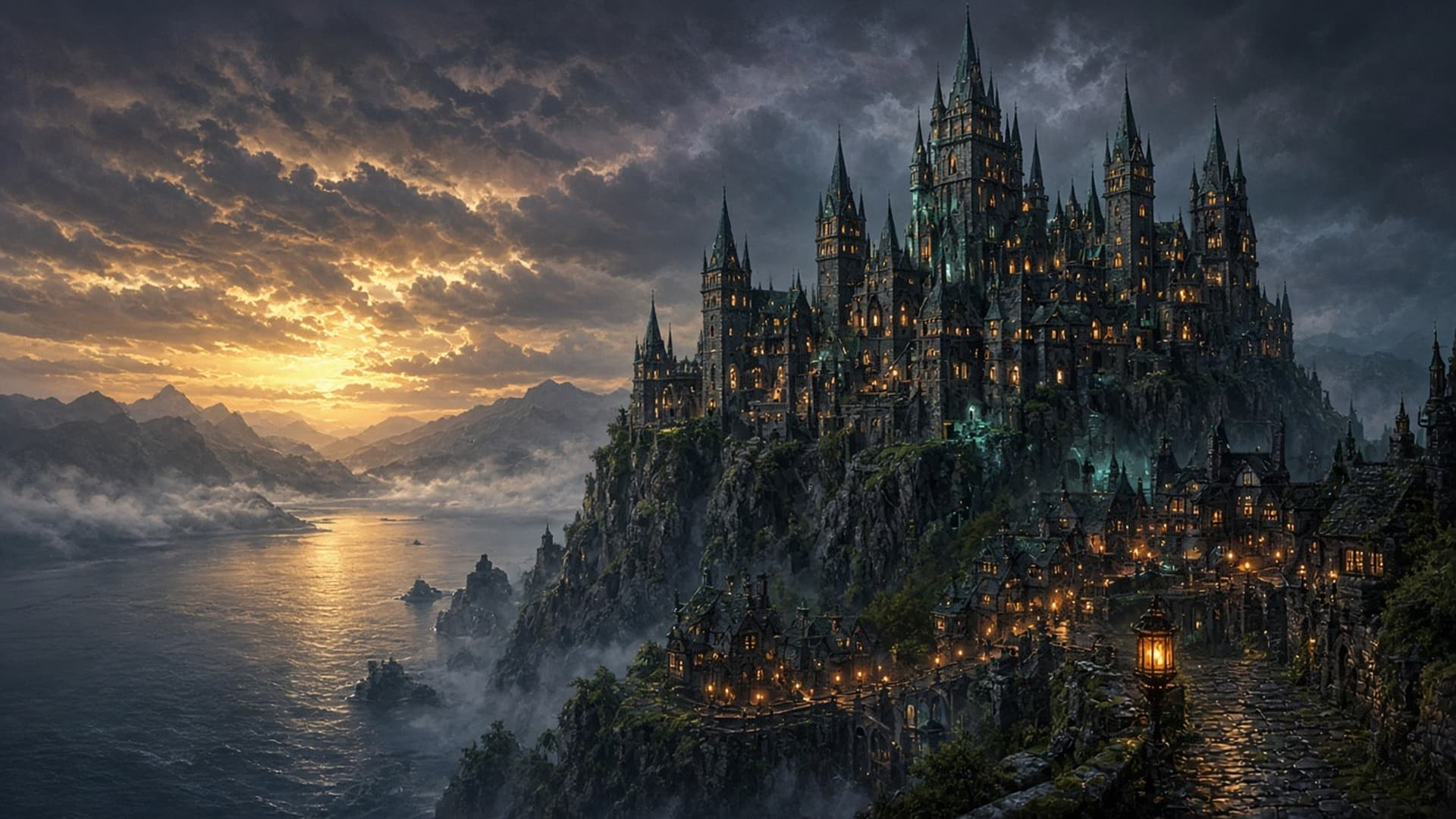
Hogwarts Legacy is getting a graphics update today, and it is not the kind that makes the game run faster. On Thursday, November 5, NVIDIA says DLSS 5 with 3D-Guided Neural Rendering arrives in the 2023 wizarding world RPG, built with Warner Bros. Games and Avalanche Software. It is a free PC update that adds a Neural Rendering option to the in-game options, and it only works on GeForce RTX 50 Series GPUs and laptops, RTX Spark PCs, and GeForce NOW Ultimate. NVIDIA lists no other hardware.
I went through NVIDIA's full Hogwarts Legacy, War Thunder and Where Winds Meet announcement line by line, then checked it against NVIDIA's driver post, the GeForce NOW post, the October 13 model announcement, and independent reporting from Tom's Hardware, Notebookcheck, heise and Creative Bloq. Where something is a vendor claim, an early test on a different game, or simply not published, I say so. I could not find official patch notes from Warner Bros. Games or Avalanche, so everything about the update itself comes from NVIDIA and the press that is repeating NVIDIA.
What Is the Hogwarts Legacy DLSS 5 Update?
DLSS 5 is the newest member of the DLSS family, and it does a different job from the ones you already know. Super Resolution renders fewer pixels and scales them up. Frame Generation and Multi Frame Generation insert extra frames. Ray Reconstruction cleans up ray traced lighting. DLSS 5 adds a final pass that uses AI to generate lighting and material detail that the engine's real time budget would normally cut.
NVIDIA's wording is that 3D-Guided Neural Rendering "uses the game engine's rendered frame, complete with its artist-designed geometry, textures and lighting buffers as an unyielding foundation," and becomes "the final rendering stage of the graphics pipeline." In plain terms, the game draws its frame like normal, and then the model takes that frame's color and motion vectors and layers better lighting and surface detail on top. NVIDIA says the result is deterministic and temporally stable, meaning it should not flicker or morph from one frame to the next.
For Hogwarts Legacy specifically, the November 3 announcement says the update uses DLSS 5's model controls "to boost environmental uplift while preserving character identity." That line is worth reading twice. NVIDIA's description of the masking tools says developers can "boost the environmental uplift while holding back on characters," so this reads as Avalanche leaning on environments and being careful with characters. That speaks directly to the criticism over how early DLSS 5 demos changed faces.
On the other side of the screen, NVIDIA's own description of what you should notice with Neural Rendering on is a short list:
- Detail and shadows in environments are enhanced.
- Texture detail on characters is improved.
- Shading and lighting are refined.
- Reflections are more vibrant.
The Avalanche quote
The only direct statement from the developer comes from Jose Villeta, Director of Software Engineering at Avalanche Software, as quoted by NVIDIA: "The team at Avalanche Software worked closely with NVIDIA to add DLSS 5 Neural Rendering technology into Hogwarts Legacy for PC to ensure the best visual results while maintaining our artistic intent. This allowed us to iterate and tune environments, tone and skin structural parameters in a manner that keeps the game true to the original vision. We're excited for players to jump back into the game and experience it in a new way."
Two things stand out. First, the quote says "for PC," so nothing here points at console versions. Second, "environments, tone and skin structural parameters" lines up with the developer controls NVIDIA describes elsewhere, namely Structure Intensity and Tone Intensity.
Release Date and Timeline
The date is Thursday, November 5, 2026. NVIDIA announced it on October 13 and repeated it on November 3. Creative Bloq and GamingBible both report it as arriving today, and NVIDIA's GeForce NOW post says it "arrives today." What nobody has published is a time of day, so if you do not see the update right away, check your launcher again later in the day before assuming something is broken.
The driver is the piece you can verify right now. NVIDIA's November 4 post says its new Game Ready driver adds "the addition of DLSS 5 with 3D-Guided Neural Rendering to Hogwarts Legacy and War Thunder," and Neowin identifies that release as GeForce Game Ready 621.14, noting that it also carries the World of Warcraft: Forever launch optimizations.
Which GPUs Support DLSS 5 in Hogwarts Legacy?
NVIDIA's wording is precise: DLSS 5 in Hogwarts Legacy is "available starting November 5th... for all GeForce RTX 50 Series GPUs and laptops, RTX Spark PCs, and GeForce NOW Ultimate." That is the entire list.
What about RTX 40 Series?
Not today. When DLSS 5 launched in September, an NVIDIA spokesperson said, as quoted by The Verge and TechPowerUp: "Our current focus is on optimizing performance for the GeForce RTX 50 Series with model updates expected later this fall. Once RTX 50 Series performance is more fully tuned, we plan to work on expanding official support to the GeForce RTX 40 Series."
So RTX 40 support is promised in principle, but no date has been given, and the November 3 announcement does not mention it. Heise made the same observation when the November 5 date was first announced. If you own an RTX 40 card, the only official route to DLSS 5 in Hogwarts Legacy right now is GeForce NOW Ultimate.
Unofficial community mods have pushed DLSS 5 onto other hardware since the model leaked in late August. Those are not part of this update, they are not supported by NVIDIA, Warner Bros. Games or Avalanche, and I am not recommending them. They matter only because some of the early performance numbers people quote come from those mods, which I flag below.
RTX Spark
RTX Spark is NVIDIA's new Arm-based Windows platform. NVIDIA describes the chip as a Blackwell RTX GPU with up to 6,144 CUDA cores and fifth-generation Tensor Cores, linked to a Grace CPU with up to 20 cores, running Windows 11. Laptops from OEM partners launched on October 16. NVIDIA's RTX Spark post lists Hogwarts Legacy as playable on those machines from launch day and says DLSS 5 is coming to them.
GeForce NOW Ultimate
The GeForce NOW post says Ultimate members get the update with "GeForce RTX 5080-class performance across PCs, Macs, handhelds, browsers, mobile devices, compatible TVs and more," with installs and updates handled by the service. Hogwarts Legacy streams from Steam, Epic Games and Xbox with Play Anywhere support. NVIDIA also notes that a day pass lets you try Performance or Ultimate before committing to a membership, and specifically suggests an Ultimate day pass for the full DLSS 5 experience in this game.
AMD, Intel and consoles
DLSS is NVIDIA technology, so Radeon and Arc cards are out. As for PlayStation and Xbox, nothing NVIDIA published applies to them, and nothing from Warner Bros. Games or Avalanche says the console versions are getting a related update. Avalanche's quote specifically says "for PC."
How to Turn On DLSS 5 in Hogwarts Legacy
NVIDIA's instructions are short: "Simply download the new update, head to the in-game options, and activate the 'Neural Rendering' option." Here is that expanded into a checklist you can follow tonight.
- Step 1: Confirm you have supported hardware. A GeForce RTX 50 Series desktop GPU or laptop, an RTX Spark PC, or a GeForce NOW Ultimate subscription.
- Step 2: Install the driver. Get GeForce Game Ready 621.14 or newer from the NVIDIA app or NVIDIA's driver page. NVIDIA's own post says to download the Game Ready driver "launching November 4th in the NVIDIA app."
- Step 3: Update the game. On PC that means letting your launcher download the Hogwarts Legacy update. If the option is missing, the update has probably not reached you yet or the driver is out of date.
- Step 4: Open the in-game options and find Neural Rendering. NVIDIA calls it the "Neural Rendering" option. I have not seen NVIDIA or the studio name which settings tab it sits on, so I am not going to guess at a menu path.
- Step 5: Switch it on and set the companion options. NVIDIA recommends turning on DLSS Super Resolution, Multi Frame Generation, Reflex and Ray Reconstruction alongside it, covered in the next section.
- Step 6: Compare in a stable spot. Stand somewhere with lots of stone, moss or foliage, toggle it, and look at the difference yourself. NVIDIA's own comparison shots are of Hogsmeade, so that is a fair place to start.
Recommended companion settings
NVIDIA's text says: "For an optimal experience, we also recommend enabling DLSS Super Resolution under 'Upscale Type', DLSS Multi Frame Generation under 'Frame Generation', NVIDIA Reflex under 'Low Latency Mode', and 'DLSS Ray Reconstruction' if you're also activating Hogwarts Legacy's immersive ray-traced effects."
One thing to keep in mind is that the extra detail from DLSS 5 builds on what the game gives it. NVIDIA's launch post for DLSS 5 says that richer source data such as ray traced or path traced lighting "yields dramatically more-accurate results," and Tom's Hardware reached a similar conclusion in its mod testing, writing that giving up ray tracing just because DLSS 5 exists does not make sense. In other words, the recommended setup is the maxed-out one, and that is also the most expensive one.
A separate optional tweak: Frame Generation Preset C
On October 13, NVIDIA released a beta "Performance Mode" for Frame Generation, labeled Preset C in the NVIDIA app's Frame Generation override. NVIDIA says it swaps the second AI model in frame generation for a lighter algorithm, with minor image quality trade-offs, and is up to 35% faster on a GeForce RTX 5060. It works on RTX 40 and RTX 50 Series GPUs and RTX Spark laptops. Treat this as a separate beta and not part of the Hogwarts Legacy update. I have not seen anyone confirm how it behaves together with Neural Rendering in this game.
Hogwarts Legacy System Requirements
Nothing published so far says DLSS 5 changes the game's base system requirements. When I checked the Steam store page, it still listed the original 2023 specs below. Those describe running the game itself, not running DLSS 5, which requires the RTX 50 Series, RTX Spark or GeForce NOW hardware covered above.
That gap is the thing to understand. The game's published recommended graphics card is a GTX 1080 Ti class card from years ago, and the hardware needed for the new option is a current generation RTX 50 Series card. NVIDIA has not published any separate minimum GPU tier inside the RTX 50 Series for Hogwarts Legacy, either. Its text says "all GeForce RTX 50 Series GPUs," and it does not say which of those will run it comfortably.
How Much Does DLSS 5 Cost in Frame Rate?
This is the question that decides whether you will actually leave Neural Rendering on, and it is also where the available information is thinnest.
What NVIDIA claims
NVIDIA says that with DLSS 3D-Guided Neural Rendering, 6X Multi Frame Generation, Ray Reconstruction, Reflex and ray tracing, max settings Hogwarts Legacy runs "at 4K at up to 300 frames per second on the GeForce RTX 5090." It also claims up to 370 frames per second at 2560x1440 and shows a 1920x1080 chart for RTX 50 Series. Those are vendor numbers, and they include generated frames from 6X Multi Frame Generation. They tell you what a full stack on the fastest card can display, not what DLSS 5 itself costs. NVIDIA published no Hogwarts Legacy number for DLSS 5 on versus off.
On the model itself, NVIDIA says the October 2026 Neural Rendering model, which Hogwarts Legacy, War Thunder and Where Winds Meet all launch with, "shrank DLSS 5's footprint by 24% to roughly 118 million parameters, while reducing 4K VRAM usage by 20%, increasing performance by 2X compared to the previous version." The October 13 post phrases it as half the GPU overhead of the September version with comparable visual fidelity. Those are NVIDIA's own measurements.
Be careful with the "2X" figure. Heise pointed out that this halves DLSS 5's share of the frame time, not the entire frame time. NVIDIA's own example supports that reading: when the faster model came to NBA 2K27 on October 16, NVIDIA said it boosted frame rates by up to 1.4X, not 2X.
What independent testers measured on earlier builds
Nobody I could find has published independent numbers for the official Hogwarts Legacy update yet. What exists is testing on earlier DLSS 5 builds, plus community mod testing on Hogwarts Legacy itself. Read this table with the caveat column in mind.
Here is how I read it. DLSS 5 has a large cost on current hardware, in the range of 40% to 58% of frame rate in the tests above, before NVIDIA's October model. Tom's Hardware also found the cost behaves differently from upscaling: the model has a fixed cost per output frame that scales with your output resolution, so lowering your internal resolution with DLSS Super Resolution helps less than you are used to. The practical lever is your output resolution.
The Tom's Hardware NBA 2K27 testing is the closest thing to a buying guide. Without frame generation, the RTX 5060 averaged nearly 60 fps at 1080p, the RTX 5060 Ti was the minimum for acceptable latency at 1440p with the RTX 5070 as the true baseline, and only the RTX 5080 and RTX 5090 made sense at 4K. That was a different game and the September model, so Hogwarts Legacy with the October model could land differently, but it gives you a rough ladder.
Why Multi Frame Generation does not fix it
Multi Frame Generation needs a decent base frame rate to feel good. Tom's Hardware found that at 4K even the RTX 5070 Ti was straining with DLSS 5 on, to the point where latency made frame generation questionable, and Notebookcheck's summary of the Digital Foundry results says MFG cannot do much when DLSS 5 itself eats a big chunk of the frame time. NVIDIA recommends Reflex alongside it for a reason.
VRAM and power
On VRAM, NVIDIA's only published number is the 20% reduction at 4K versus the September model, and it is about the model, not Hogwarts Legacy. Tom's Hardware's NBA 2K27 testing found that all three 8 GB RTX 50 cards might struggle to fit the game, the DLSS 5 model and the frame generation model in memory with maxed settings, and suggested turning off ray tracing at a minimum to use frame generation on them. Again, different game and model, so take it as a warning sign, not a Hogwarts Legacy measurement.
On power, DLSS 5 is heavy on Tensor Cores. In Tom's Hardware's Hogwarts Legacy mod test, a 1000 W MSI RTX 5090 Lightning Z went from 480 W to 720 W with DLSS 5 on. That is an extreme card, not a typical one, but Tom's also found the RTX 5090 Founders Edition sitting at or near its power limit with neural rendering on. If your cooling and power supply are borderline, this is a good game to watch temperatures in.
How Does It Look? Early Reactions
The official comparisons are Hogsmeade. NVIDIA says enabling DLSS 5 "introduces more realistic lighting and materials in the entire scene," pointing to weathered roofs where "the creeping moss" pops against the shingles, and window boxes and potted flowers with localized shadows. In a second scene it points to richer contact shadows in recessed archways and more contrast in the crevices of sunlit stone walls. Those are NVIDIA's descriptions of its own images.
Independent reaction so far is mixed, with a consistent theme: it is subtle. Creative Bloq says the impact "looks surprisingly subtle" in NVIDIA's launch trailer, notes that some viewers are struggling to see a worthwhile difference even in side by side comparisons, and says the extra detail in some environments makes them feel less atmospheric in the writer's own opinion. GamingBible writes that details feel more defined and textures more visible in the trailer, and that early comments say it may now be almost too subtle compared with the leaked version. Those are reactions to a YouTube trailer, not hands-on testing of the live game.
The bigger context is the controversy that followed DLSS 5's March reveal and the leaked early build in August, when faces were the main complaint. In the official integration, Avalanche and NVIDIA say they tuned the effect to avoid that. Whether you like the finished result is going to be a matter of taste, and the toggle exists so you can decide for yourself. For a more positive take on a different game, Tom's Hardware called the NBA 2K27 implementation "incredible," but that is a sports game with very different content.
War Thunder and Where Winds Meet Get DLSS 5 Too
Hogwarts Legacy is the first of three games NVIDIA announced for November.
- War Thunder, mid-November. DLSS 5 arrives with the Eagle's Shadow major update, which NVIDIA says also brings dozens of new planes, ships and tanks and cluster bombs for planes. Gaijin's own announcement says DLSS 5 is enabled for RTX devices in that update, and that on RTX 50 Series cards and RTX Spark devices it unlocks the engine's full potential including path tracing. A Gaijin administrator replied to a player that it is an RTX 50 Series and RTX Spark feature at this point and that they had no information on RTX 40 compatibility. NVIDIA says mid-November, and neither NVIDIA nor the Gaijin post I read gives an exact date.
- Where Winds Meet, November 23. NVIDIA says developer Everstone Studio and NetEase Games "maximized DLSS 5's settings" for the game's Wuxia world. NVIDIA says the game has more than 100 million players worldwide and has peaked at over 250,000 concurrent players on Steam.
What Is Still Unconfirmed
Here is the honest list of what I could not verify as of the morning of November 5, Central time.
The first one matters for how much weight to put on this article. When a game gets an update, I normally lean on the studio's own notes. Here the studio's voice is one quote that NVIDIA published, and the rest is NVIDIA's own description. That is not a reason to distrust the update, but it is a reason to wait for independent testing before deciding the 300 fps headline reflects your experience.
Is DLSS 5 in Hogwarts Legacy Worth Turning On?
If you have an RTX 50 Series card, it is a free option and it costs nothing to try, so try it. Update, enable Neural Rendering, set the companion options NVIDIA recommends, and flip it on and off in a place you know well. If you are on a mid-range RTX 50 card, do not be surprised if the cost is steep, and think about whether you would rather have the frame rate. If you are on RTX 40 Series or older, there is nothing to switch on locally, and the only official way to see it is a GeForce NOW Ultimate day pass. For everyone else, it changes nothing about the game you already own.
Frequently Asked Questions
When does DLSS 5 come to Hogwarts Legacy?
NVIDIA says it arrives on Thursday, November 5, 2026, in an update built with Warner Bros. Games and Avalanche Software. NVIDIA's GeForce NOW post and press coverage describe it as arriving today. No time of day has been published, so check your launcher for the update and make sure your GeForce driver is current.
How do I enable DLSS 5 in Hogwarts Legacy?
Install the new update, open the in-game options, and turn on the Neural Rendering option. NVIDIA also recommends installing the Game Ready driver released on November 4, which Neowin identifies as version 621.14, and enabling DLSS Super Resolution under Upscale Type, Multi Frame Generation under Frame Generation, Reflex under Low Latency Mode and Ray Reconstruction if you use ray tracing.
Which GPUs support DLSS 5 in Hogwarts Legacy?
NVIDIA lists all GeForce RTX 50 Series GPUs and laptops, RTX Spark PCs and GeForce NOW Ultimate. RTX 40 Series and older GPUs are not on the list. NVIDIA has said it plans to expand official support to the RTX 40 Series once RTX 50 Series performance is tuned, but it has not given a date.
Does DLSS 5 work on an RTX 4090 or RTX 4080?
Not officially. NVIDIA has said RTX 40 Series support will come later, with no date. The only official way for an RTX 40 Series owner to use DLSS 5 in Hogwarts Legacy today is to stream the game on GeForce NOW Ultimate, which uses NVIDIA's cloud hardware.
Does DLSS 5 make Hogwarts Legacy run faster?
No. DLSS 5 Neural Rendering is a visual quality feature with a performance cost. NVIDIA's headline numbers of up to 300 fps at 4K on an RTX 5090 and up to 370 fps at 1440p include 6X Multi Frame Generation and other DLSS features. Independent testing of earlier DLSS 5 builds in other games showed frame rate losses of roughly 40% to 58%, before NVIDIA's faster October model.
Does DLSS 5 change character faces in Hogwarts Legacy?
NVIDIA and Avalanche say the update is tuned to boost environmental detail while preserving character identity, and that skin structural parameters were tuned to keep the game true to its original vision. Character textures do get more detail according to NVIDIA. Beyond NVIDIA's comparison shots and launch trailer, I have not seen independent close comparisons of faces in the live game.
What are the Hogwarts Legacy system requirements for DLSS 5?
No new system requirements have been published for the update. The Steam page lists the original specs, with a GTX 960 4 GB or RX 470 4 GB as minimum and a GTX 1080 Ti, RX 5700 XT or Arc A770 as recommended. To use DLSS 5 itself, you need a GeForce RTX 50 Series GPU, an RTX Spark PC or a GeForce NOW Ultimate subscription.
Is the DLSS 5 update free?
NVIDIA describes it as an update to the game, and I have not seen any extra charge announced. GamingBible calls it a free update. If you stream through GeForce NOW instead, you need an Ultimate membership, and NVIDIA says a day pass is available as a way to try it before committing.
Is DLSS 5 available on consoles or Steam Deck?
Nothing NVIDIA or the publisher published says so. DLSS is NVIDIA RTX technology, and Avalanche's quote refers specifically to the PC version. I have not seen any statement about consoles getting a matching update.
Which other games are getting DLSS 5 in November?
War Thunder gets DLSS 5 in mid-November with its Eagle's Shadow major update, and Where Winds Meet gets it on November 23. NBA 2K27 was the first game to launch with DLSS 5, in early September. NVIDIA says more titles will follow in the coming weeks and months.
Will DLSS 5 melt my GPU?
There is no evidence of that from the official Hogwarts Legacy update, and I would not frame it that way. What testers did measure is that DLSS 5 puts a heavy load on Tensor Cores and raises power draw. Tom's Hardware found an RTX 5090 Founders Edition at or near its power limit with neural rendering on, and a 1000 W card pulling 720 W in Hogwarts Legacy through a community mod. Keep an eye on temperatures, and make sure your power connection is seated properly.
Is the Hogwarts Legacy DLSS 5 update worth it?
It depends on your card and your taste. If you have an RTX 50 Series GPU, it is a free toggle you can test in minutes. Reaction so far calls the visual difference subtle, and the frame rate cost has been large on earlier DLSS 5 builds, so test it on your own screen before deciding whether to leave it on.